Measurement & scaling

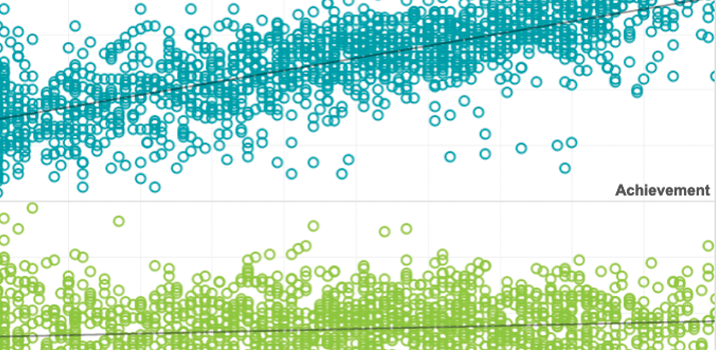
Social-emotional learning (SEL) is gaining prominence in education practice and policy. Research shows that SEL can be improved by short-term, targeted interventions and longer-term strategies to improve school contextual factors. The present study examines the stability of academic achievement relative to four SEL domains (growth mindset, self-efficacy, social awareness, and self-management).
Topics: Measurement & scaling, Social-emotional learning, Student growth & accountability policies
The (non)impact of differential test taker engagement on aggregated scores
Disengaged test taking tends to be most prevalent with low-stakes tests. This has led to questions about the validity of aggregated scores from large-scale international assessments such as PISA and TIMSS, as previous research has found a meaningful correlation between the mean engagement and mean performance of countries.
An information-based approach to identifying rapid-guessing thresholds
Although several common threshold methods are based on rapid guessing response accuracy or visual inspection of response time distributions, this paper describes a new information-based approach to setting thresholds that does not share the limitations of other methods.
The emerging science of test-taking disengagement
Student performance on standardized tests reflects more than just mastery of the material.
Topics: Measurement & scaling, Innovations in reporting & assessment, School & test engagement

Measuring the impact of test disengagement on estimates of educational effectiveness
Learn more about our examination of student disengagement and how it may bias estimates of effectiveness based on observed test results.
Topics: Measurement & scaling, School & test engagement, Student growth & accountability policies

The impact of proctor notification when students disengage
How do you help make sure students give their best effort on testing day? New research on student test engagement shows how proctor notification can make a significant impact.
Topics: Measurement & scaling, Innovations in reporting & assessment, School & test engagement

What happens when test takers disengage? Understanding and addressing rapid guessing
How does rapid-guessing differ from solution behavior? Research provides insight into test disengagement and how disengagement should be managed in scoring.