Data visualization
Do high flyers maintain their altitude?
2011
Description
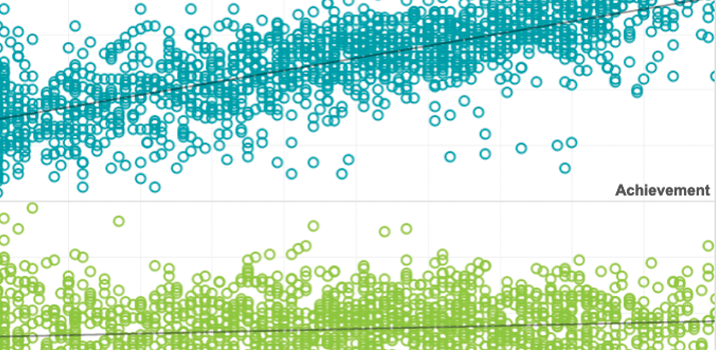
If America is to remain internationally competitive with other advanced nations, we must maximize the academic potential of our top students. To date, few research studies have examined the progress of individual high achievers over time in relation to other students. The analysis in the Fordham Institute report Do High Flyers Maintain Their Altitude and the corresponding visualizations in this gallery helps to fill that gap. In the visualizations in this exhibit, you can compare the performance and growth of various groups of high achievers to that of their peers over multiple years. We wish to thank the Thomas B. Fordham Institute and the Kern Family Foundation for their support of this study.
See MoreTopics: Equity, High-growth schools & practices
Associated Research
Related Topics
Finding root causes effectively: A powerful way to improve schools
Using experience gained by facilitating the determination of root causes in schools and in industrial settings, as well as lessons from research and literature both within and outside of education, this paper provides a recommend process, and detailed protocols and tools for defining problems to be investigated and determining their root causes.
Topics: High-growth schools & practices

Moving from data to making a difference
The problems faced within education resemble the problems in many social settings in that they lack clear definitions, have many potential causes, lack simple solutions, and defy straightforward measurement. In this article, Andrew Hegedus shares a view on the types of problems faced in education and outlines key characteristics of a process that begins with collecting data and ends with evaluating progress.
Topics: Empowering educators, High school, High-growth schools & practices
A level playing field: College readiness standards
Some of our assumptions about the growth and performance of students from high-poverty schools relative to their peers from wealthier schools may be challenged in this data gallery, where you can explore how school poverty level interacts with student growth, college readiness, and college access.
Topics: Equity, College & career readiness
A level playing field: College readiness standards
This study examines the academic growth of 35,000 elementary and middle school students in 31 states—all of them high achievers within their own schools—over a three-year period.
Topics: Equity, College & career readiness
Making teacher goal setting more powerful
Most of us believe that when individuals have goals, their performance improves, and this belief is being put to the test in schools today. In an effort to create alignment between district and school improvement efforts, teachers are more likely than ever to have formal performance goals.
Topics: Empowering educators, High-growth schools & practices

What does equity and accessibility look like within assessment?
Creating tests and items from the beginning with Universal Design for Learning in mind, removing barriers by adding alt-tags, and incorporating more culturally rich materials are all steps NWEA is doing to improve our equity for all students.
Topics: Equity, Accessibility
NWEA promotes accessibility in assessment with release of image description guidelines
Image descriptions are important to make computer-based assessments accessible to students using assistive technology (AT) devices, such as screen readers and refreshable braille displays. NWEA, with support from the National Center for Accessible Media (NCAM), has created guidelines for describing many variations of images, charts, and graphics targeted specifically to the disciplines of reading, language usage, science, and mathematics.
Topics: Equity, Accessibility