White paper
Do high flyers maintain their altitude? Performance trends of top students
2013

Description
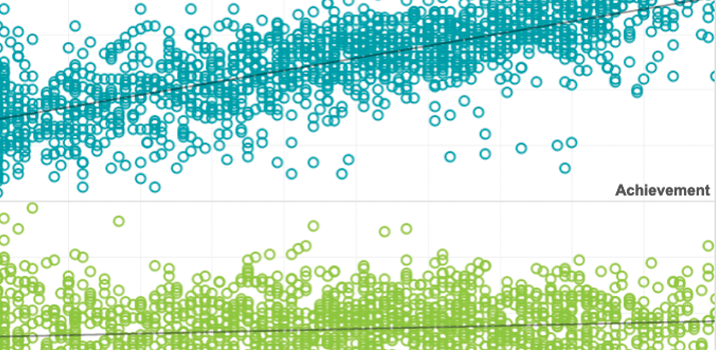
In this study from the Thomas B. Fordham Institute, achievement trends from NWEA’s longitudinal growth database were used to track students who scored at or above the 90th percentile on this assessment in order to see if they maintained their high achievement. The middle school/high school cohort consisted of 91,643 students from more than 800 schools in 28 states. Around three in five students identified as high-achieving in the first year of the study remained high-achieving in the last year of the study. Students who fell below the 90th percentile typically stayed at the 70th percentile or higher.
See MoreTopics: Equity, High-growth schools & practices
Related Topics

This white paper examines the landscape of middle school science course offerings, enrollment patterns, and assessment outcomes. The analysis of data from 2,200 schools finds that multi-disciplinary course models now dominate versus single-course offerings, though access to course types varies by race and ethnicity. In addition, students in different course models performed similarly on assessments.
Products: MAP Growth
Topics: Equity, Math & STEM

A Practical Guide for Considering and Interpreting Test Score Differences Among Student Subgroups
This guide offers recommendations for how to understand what differences may exist when looking at data for student groups, and gives leaders some structure for how they might consider and interpret those differences.
Products: MAP Growth
Topics: Empowering educators, Equity, Growth, Guidance

Spanish MAP Reading Fluency Technical Report
This technical report outlines the design, scoring, reliability, and validity of the Spanish MAP Reading Fluency assessment, demonstrating how it measures foundational skills and oral reading fluency to support early literacy development.
Products: MAP Reading Fluency
Topics: Early learning, Equity, Measurement & scaling, Test design
MAP Growth Spanish Technical Report- Addendum
This technical addendum report is written to help measurement professionals and administrators evaluate the quality of the MAP Growth’s Spanish assessments.
Products: MAP Growth, MAP Spanish
Topics: Equity, Item response theory, Measurement & scaling, Test design

From loss to recovery: Diverging paths and uneven gains across schools
This research brief examines two components of school recovery post-COVID pandemic to better understand recovery patterns. These include initial declines in average achievement and post-pandemic gains in average achievement across schools. By understanding these different recovery patterns, the brief offers insights to policy makers and leaders where to invest for long-term improvement and targeting support where it is needed most.
Topics: COVID-19 & schools, Growth, High-growth schools & practices, Seasonal learning patterns & summer loss

Tech Appendix for “From loss to recovery: Diverging paths and uneven gains across schools”
This is the technical appendix to the research brief titled, “From loss to recovery: Diverging paths and uneven gains across schools,” which examines two components of school recovery post-COVID pandemic to better understand recovery patterns.
Topics: COVID-19 & schools, Growth, High-growth schools & practices, Seasonal learning patterns & summer loss

Unequal Access to 8th-Grade Algebra: How School Offerings and Placement Practices Limit Opportunity
This NWEA research brief examines how access to early Algebra – a key gateway to advanced high school math, STEM majors, and higher lifetime earnings – remains highly inequitable across the United States. Using NWEA data from 162,000 eighth-grade students across 22 states, the study looks at both whether schools offer Algebra by 8th grade and how students are placed when it is offered. The findings point to significant gaps tied to school poverty levels, geography, and race/ethnicity.
Topics: College & career readiness, Equity, Math & STEM