Journal article
It matters how you start: Early numeracy mastery predicts high school math course-taking and college attendance
2021
Infant and Child Development. https://doi.org/10.1002/icd.2281

Abstract
Using data from the Applied Problems subtest of the Woodcock-Johnson Tests of Achievement (Woodcock & Johnson, 1989/1990, Woodcock-Johnson psycho-educational battery-revised. Allen, TX: DLM Teaching Resources) administered to 1,364 children from the National Institute of Child Health and Human Development (NICHD) Study of Early Childcare and Youth Development (SECCYD), this study measures children’s mastery of three numeric competencies (counting, concrete representational arithmetic and abstract arithmetic operations) at 54 months of age.
See MoreThis article was published outside of NWEA. The full text can be found at the link above.
Related Topics

This is the technical appendix to the research brief, “The Power of Connectedness: A Case for a Coherent Instructional System for Reading and Science Improvement,” which examines the practices and conditions of a coherent instructional system, and where and how it had the most impact.
Products: MAP Growth
Topics: Empowering educators, Growth, Informing instruction, Math & STEM

Using a case study from a U.S. school district, this research brief examines the practices and conditions of a coherent instructional system, and where and how it had the most impact. It offers a practical model that leaders can adapt in their own schools to help strengthen instruction across classrooms.
Products: MAP Growth
Topics: Empowering educators, Growth, Informing instruction, Math & STEM

Using data from the MAP Growth National Dashboard, this Trends Snapshot report focuses on academic growth trends post-COVID and points to a positive turn for U.S. reading after years of stagnation. This positive trend was also noted for historically underserved groups who showed the largest reading gains from 2025 to 2026.
Products: MAP Growth
Topics: COVID-19 & schools, Growth, Math & STEM, Reading & language arts
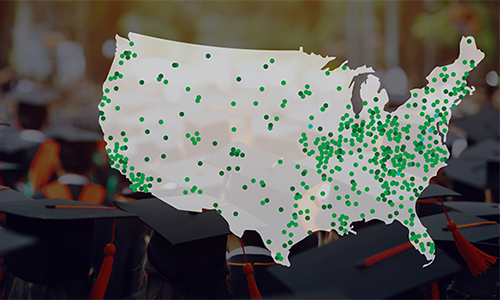
The College Explorer from NWEA® helps students, parents, and teachers develop pathways to higher education. This powerful tool links MAP® Growth™ scores with national benchmarks for colleges, universities, and even specific majors. Together with goal setting and parent conferences, College Explorer can help students develop a plan, consider new possibilities, and put post-secondary dreams within reach.
Topics: Innovations in reporting & assessment, College & career readiness, High school

Achievement and Growth Norms for Spanish MAP Reading Fluency Foundational Skills
This technical report presents achievement and growth norms for Spanish MAP Reading Fluency Foundational Skills (grades K–3), enabling educators to interpret student performance and progress in early literacy domains relative to national peer groups.
Products: MAP Reading Fluency
Topics: Early learning, Item response theory, Measurement & scaling, Test design
This is the technical appendix to the research brief, “Getting Algebra Placement Right: Expanding Opportunity and Strengthening Preparation,” which examines whether taking Algebra in 8th grade instead of 9th grade improves student outcomes.
Products: MAP Growth
Topics: Empowering educators, Growth, Informing instruction, Math & STEM, Middle school

Getting Algebra Placement Right: Expanding Opportunity and Strengthening Preparation
This research brief examines whether taking Algebra in 8th grade instead of 9th grade improves student outcomes. Using a nationwide sample of MAP Growth scores for middle schoolers, NWEA researchers looked at how many students who were ready for Algebra actually enrolled, and how outcomes were affected for students who were or were not ready for the course.
Products: MAP Growth
Topics: Empowering educators, Growth, Informing instruction, Math & STEM, Middle school