Social-emotional learning
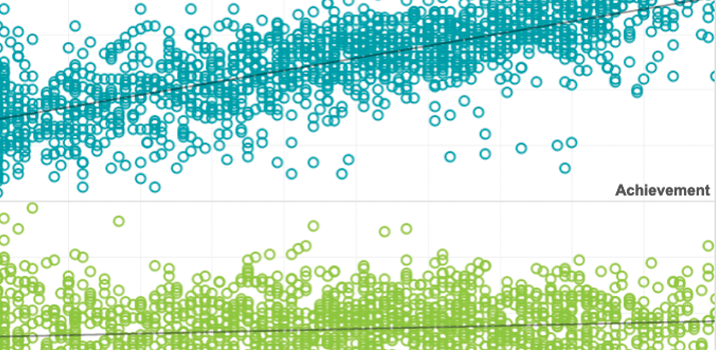
Students don’t learn only during the school year, and academic growth trajectories can change as students move from kindergarten through high school. Academic growth patterns across time—both in school and during the summer—can differ for various groups of students, and those patterns can influence academic achievement gaps. Our research advances understanding of seasonal learning patterns, summer loss, and school and non-school contributions to student growth.

This study investigates whether rapid guessing is a stable trait-like behavior or if rapid guessing is determined mostly by situational variables, and whether rapid guessing over the course of several tests is associated with certain psychological and background measures. We find that rapid guessing tends to be more state-like compared to academic achievement scores, which are fairly stable and that repeated rapid guessing is strongly associated with students’ academic self-efficacy and self-management scores.
Topics: Measurement & scaling, School & test engagement, Social-emotional learning
How to support ELL students: A Q&A with Dr. Jim Soland
In this interview, James Soland discusses his research exploring the connection between social-emotional learning and growth in achievement for English language learner students.
Topics: Student growth & accountability policies, English Language Learners, Social-emotional learning

Do students’ social-emotional learning (SEL) skills in middle school predict being off-track to graduate high school?
Topics: Growth modeling, Social-emotional learning

Self-efficacy and the ELL achievement gap
In this webinar, learn more about the relationship between self-efficacy and the achievement gap for English Language Learners (ELLs).
Topics: Equity, English Language Learners, Social-emotional learning
Through a series of simulation and empirical studies, we produce scores in a single-cohort repeated measure design using sum scores as well as multiple IRT approaches and compare the recovery of growth estimates from longitudinal growth models using each set of scores.
Topics: Growth modeling, Social-emotional learning
In this study, we conducted empirical and simulation analyses in which we scored surveys using item response theory (IRT) models that do and do not account for response styles, and then used those different scores in growth models and compared results.
Topics: Measurement & scaling, Growth modeling, Social-emotional learning
Correlates of change in elementary students’ perceptions of interactions with their teacher
This study leveraged a racially/ethnically diverse sample of third and fourth grade students and teachers in a large, urban district to investigate whether stable student and teacher characteristics (e.g., sex) and observed quality of classroom interactions influenced change in students’ perceptions of interactions with their teacher.
Topics: Equity, Social-emotional learning