Equity
It remains a critical challenge to ensure all children—regardless of race, ethnicity, gender, socio-economic status, and/or ability—have access to a high-quality education. We are at a pivotal time where communities and schools are navigating issues of equity, poverty, and opportunity gaps against a backdrop of shifting education policy. With access to exceptional data and a multi-disciplinary team of researchers and research partners, we are able to provide unique insight into these important issues.

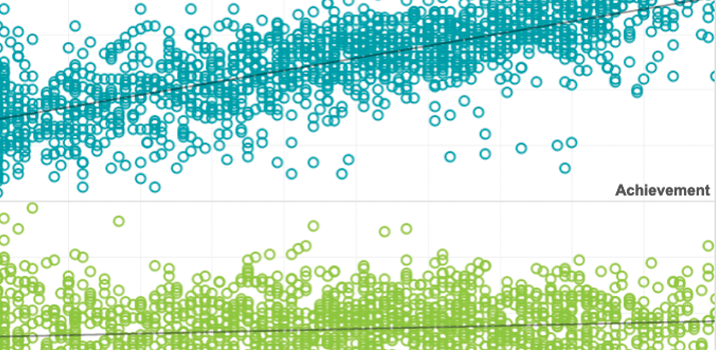
How does schooling affect inequality in students’ academic skills? This study uses seasonal comparisons to examine the possibilities that schooling exacerbates, reduces, or reproduces overall skill inequality in math, reading, language use, and science with recent national data on US public school students spanning numerous grade levels from the NWEA MAP Growth assessment. Results suggest that schooling has a compensatory effect on inequality in reading, language, and science skills but not math skills. Theoretical implications of findings are discussed.
Disparities and discrimination in student discipline by race and family income
Black and poor students are suspended from U.S. schools at higher rates than White and nonpoor students. While the existence of these disparities has been clear, the causes have not. By comparing the punishments given to Black and White (or poor and nonpoor) students who fight one another, the study addresses a challenge that has kept prior studies from identifying discrimination in student discipline. It finds that Black and poor students are punished more harshly than the students with whom they fight.
Topics: Equity

MAP Reading Fluency theory of action
The MAP Reading Fluency theory of action shows the hypothesized mechanisms of change and intermediate goals leading to the overarching goal of helping all students read fluently with comprehension.
Products: MAP Reading Fluency
Topics: Equity, Measurement & scaling

Learning during COVID-19: Reading and math achievement in the 2020-2021 school year
To what extent did COVID-19 disruptions affect student achievement in 2020-2021, and which students have been most affected? New NWEA research aims to provide insight to inform leaders working to support recovery: using data from 5.5 million students in grades 3-8 who took MAP Growth assessments in reading and math, this brief examines how gains across the 2020-21 school year and student achievement in spring 2021 compare to pre-pandemic trends.
Topics: COVID-19 & schools, Equity
The purpose of this technical appendix is to share more detailed results and to describe more fully the sample and methods used in the research included in the brief, Learning during COVID-19: Reading and math achievement in the 2020-21 school year.
Two research questions were investigated in this brief:
1. How do gains across the 2020-21 school year compare to pre-pandemic trends?
2. How does student achievement in spring of 2021 compare to pre-pandemic levels?
Topics: COVID-19 & schools, Equity
The impact of disengaged test taking on a state’s accountability test results
This study investigated test-taking engagement on a large-scale state summative assessment. Overall, results of this study indicate that disengagement has a material impact on individual state summative test scores, though its impact on score aggregations may be relatively minor.
Topics: Equity, Measurement & scaling, School & test engagement

In this webinar offered in partnership by the Alliance for Excellent Education, NWEA, the National Urban League, and Unidos US, learn about new NWEA research on academic trends of students during the past school year compared to a more typical school year, what these findings suggest about widening education inequality, recommendations for states and districts on how to use recent federal aid to transform education for historically underserved students, and the perspective a a district leader on what their district is doing to support students as they return to school.
Topics: Equity, COVID-19 & schools