Presentation
A “Lost Year” of Data? What Disruptions From COVID-19 Mean For Education Research
2020
Description
This Bellwether Education Partners webinar brings together academic and government experts to discuss how education research can continue to offer meaningful, relevant information to policymakers and practitioners after the “lost year” of data from COVID disruptions to schools and testing, and how the pursuit of evidence to improve our education systems and policies can rebound from this moment. How should educators and evaluators measure student performance moving forward, and what proof points can they use to guide their efforts? What stopgaps are researchers putting in place to address missing data, and how is the U.S. Department of Education considering long-term data collection efforts? What interventions can be used remotely to support equity and inclusion?
See MoreRelated Topics

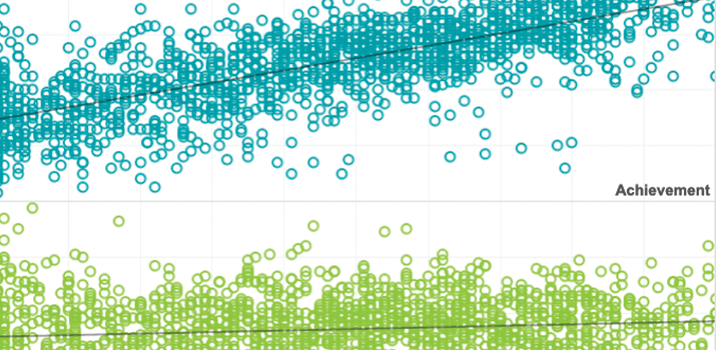
Missing at the Top: Lower-income Students Underrepresented Among High Achievers
This research brief examines whether lower-income students who show high math achievement early in school are being identified and supported to sustain their success. The research addresses a broader concern that socioeconomic gaps in advanced learning opportunities may contribute to high-achieving, lower-income students falling off the path to advanced math, STEM education and careers.
Products: MAP Growth
Topics: Advanced Learning, Empowering educators, Growth, Math & STEM
This is the technical appendix to the research brief, Missing at the Top: Lower-income Students Underrepresented Among High Achievers, which examines whether lower-income students who show high math achievement early in school are being identified and supported to sustain their success.
Products: MAP Growth
Topics: Advanced Learning, Empowering educators, Growth, Math & STEM

MAP Growth Course-Specific Tests Technical Report for 2024–2025
This comprehensive technical report documents the design, development, and validation of MAP Growth Course-Specific assessments for the 2024–2025 school year. It presents evidence of psychometric quality, including adaptive testing methods, reliability, validity, fairness, and score interpretation across grades and courses.
Products: MAP Growth
Topics: Computer adaptive testing, Item response theory, Measurement & scaling, Test design

Using a case study from a U.S. school district, this research brief examines the practices and conditions of a coherent instructional system, and where and how it had the most impact. It offers a practical model that leaders can adapt in their own schools to help strengthen instruction across classrooms.
Products: MAP Growth
Topics: Empowering educators, Growth, Informing instruction, Math & STEM
This is the technical appendix to the research brief, “The Power of Connectedness: A Case for a Coherent Instructional System for Reading and Science Improvement,” which examines the practices and conditions of a coherent instructional system, and where and how it had the most impact.
Products: MAP Growth
Topics: Empowering educators, Growth, Informing instruction, Math & STEM

Using data from the MAP Growth National Dashboard, this Trends Snapshot report focuses on academic growth trends post-COVID and points to a positive turn for U.S. reading after years of stagnation. This positive trend was also noted for historically underserved groups who showed the largest reading gains from 2025 to 2026.
Products: MAP Growth
Topics: COVID-19 & schools, Growth, Math & STEM, Reading & language arts
Achievement and Growth Norms for Spanish MAP Reading Fluency Foundational Skills
This technical report presents achievement and growth norms for Spanish MAP Reading Fluency Foundational Skills (grades K–3), enabling educators to interpret student performance and progress in early literacy domains relative to national peer groups.
Products: MAP Reading Fluency
Topics: Early learning, Item response theory, Measurement & scaling, Test design