
 Every year, middle school leaders face one of the most consequential placement decisions in students’ math pathway: which students should take Algebra 1 in eighth grade, and which would benefit from additional preparation before enrolling. This decision matters because Algebra 1 is a gateway course that opens access to advanced mathematics, college-ready coursework, and STEM opportunities in high school and beyond. At the same time, placing students into algebra before they are prepared can lead to unnecessary difficulties and missed confidence-building opportunities.
For school leaders, the challenge is not simply whether students should take algebra earlier or later. The more important question is whether individual students are ready and how districts can make algebra placement decisions that are both equitable and evidence based.
What is “algebra readiness”?
“Algebra readiness” can be defined in two ways.
A district may consider students ready when they can demonstrate specific prerequisite skills, earn a passing course grade, meet a state assessment standard, or continue successfully into higher-level mathematics.
On the NWEA research team, we use the estimated likelihood that a student will meet the proficiency standard on a state Algebra 1 end-of-course assessment as the indicator of Algebra 1 readiness. Specifically, students are categorized as ready if they have at least a 50% probability of reaching proficiency on the state Algebra 1 end-of-course test.
The problem: Opportunity and readiness do not always align
My colleagues and I recently examined the impacts of algebra placement decisions and found that many districts may be leaving opportunity on the table. Among students who appear academically ready for eighth-grade algebra, nearly one-quarter do not enroll in the course, even when their school offers it.
This finding highlights a common challenge in course placement systems: traditional placement processes have relied heavily on teacher recommendations, parent advocacy, past course enrollment patterns, or informal judgments. While each of these sources can provide useful information, they can also lead to inconsistency and unintended inequities. Students who are academically prepared may be overlooked, while others may gain access primarily because they have stronger advocates.
Fair placement systems require a more intentional approach to algebra placement that identifies students based on evidence of readiness rather than assumptions about potential.
Students who are ready shouldn’t wait
One argument often made in favor of delaying algebra is that additional time will allow students to strengthen foundational math skills before entering a more rigorous course. While this may sound reasonable, the evidence suggests that delaying algebra may actually disadvantage many students who are already prepared.
Using a national sample of approximately 55,000 students, my colleagues and I compared algebra outcomes for similar students who took the course in eighth grade versus ninth grade. We found that students with stronger prior mathematics achievement generally performed better when they took algebra in eighth grade. This advantage was evident across much of the upper half of the achievement distribution and was particularly large among the highest-achieving students.
In other words, for many students who are ready, waiting does not improve outcomes. In fact, delaying access may reduce achievement and limit later opportunities to take advanced mathematics courses, such as Geometry, Algebra II, Precalculus, AP Calculus, and AP Statistics.
More time is not enough for students who are not ready
Our findings also challenge another common assumption: students who have difficulties with mathematics will automatically benefit from postponing algebra for one year. Our study found that students in the lower half of the prior achievement distribution performed similarly whether they took algebra in eighth grade or ninth. More importantly, these students generally remained below the algebra proficiency benchmark regardless of when they took the course.
This suggests that simply delaying enrollment is rarely a solution by itself. Students who are not yet ready typically need stronger instruction, targeted interventions, better curriculum alignment, additional learning time, or enhanced academic supports. An algebra placement decision alone cannot solve underlying preparation challenges. For school leaders, this distinction is critical. The conversation should move beyond eighth-grade versus ninth-grade algebra and focus instead on providing each student with the preparation and support they need to succeed.
MAP Growth algebra readiness benchmarks
An important step that school and state leaders can take is defining an objective measure of algebra readiness. Some schools focus on course grades, while others rely on state assessments, prerequisite skills, or local expectations for success.
The MAP Growth Algebra 1 Placement Guide offers a more standardized approach by defining readiness as the likelihood that a student will meet proficiency standards on a state Algebra 1 end-of-course assessment. Specifically, a student is considered ready when they have at least a 50% probability of reaching proficiency on the state algebra assessment after taking the course.
For states with Algebra 1 linking studies (Georgia, North Carolina, Ohio, and Texas), we have state-specific readiness benchmarks, shown in Table 1 below. For all other states, we calculated a set of national benchmarks based on the available state-level estimates.
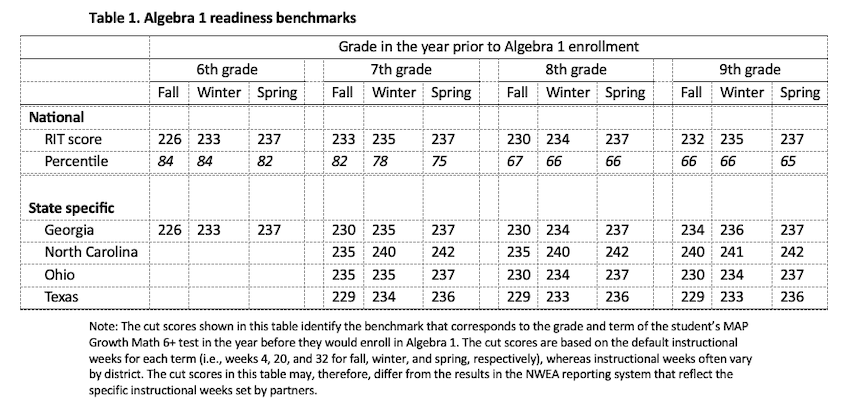
Consider a hypothetical student who takes MAP Growth 6+ Math in the spring of seventh grade and is being considered for placement in Algebra 1 in eighth grade. The applicable national benchmark is the spring of seventh grade RIT score of 237 (the 75th percentile). The same benchmark applies if the student is in Georgia or Ohio, but Texas’s benchmark is one point lower (236) and North Carolina’s is five points higher (242).
This type of benchmark provides educators with a clear, research-based indicator that can supplement local decision making. Importantly, readiness benchmarks should not be viewed as guarantees. Students who meet a benchmark are not certain to succeed, and students who fall below a benchmark can absolutely be successful with appropriate support. Rather, the benchmarks provide a consistent source of evidence that helps districts make more informed decisions.
How MAP Growth supports fairer placement decisions
MAP® Growth™ can help schools create more transparent and equitable algebra placement systems in a few ways:
- MAP Growth provides a common measure that can be applied consistently across all students. This reduces dependence on subjective measures and makes it less likely that students will be overlooked because of differences in advocacy, expectations, or local practices.
- MAP Growth readiness benchmarks allow districts to estimate which students are more likely to meet algebra proficiency standards. The benchmarks are derived from linking studies that connect MAP Growth Math performance to state Algebra 1 end-of-course assessments.
- MAP Growth data can help identify students who may need additional review or supports. Rather than viewing readiness as a simple yes-or-no decision, districts can use assessment information to create tailored pathways, including accelerated opportunities for students who are ready and targeted interventions for students who need more preparation.
The bottom line
Algebra placement is not simply a scheduling decision. It is an opportunity decision.
The evidence suggests that many students who are academically ready for algebra are not currently receiving access to it, while students who are not yet prepared often need more than just additional time before enrollment. Thoughtful placement systems should focus on identifying readiness, expanding opportunities for qualified students, and providing meaningful supports for those who need additional preparation.
MAP Growth provides school leaders with a valuable tool for achieving these goals. By combining objective readiness benchmarks with local knowledge and multiple measures of student success, districts can make placement decisions that are more transparent, equitable, and likely to help every student reach their mathematical potential.