 Reaching proficiency in math and reading by third grade is often described as a critical educational milestone—and for good reason. By third grade, students are expected to move beyond learning foundational skills and begin using those skills to access increasingly complex academic content. Research has also shown that achievement in third grade is strongly related to later educational outcomes, making it an important indicator of whether students are on track for future success.
But what if educators could identify students at risk of missing this milestone years before third grade? My NWEA colleagues and I recently published a study demonstrating that students who are at risk of missing third-grade proficiency can often be identified years before that benchmark is measured. The findings offer a clear message for educators: students’ kindergarten achievement levels provide powerful information about future outcomes, making early screening and intervention more important than ever.
Students begin school on different academic trajectories
Educators have long known that children arrive at kindergarten with varying levels of preparation. What is less well understood is how those initial differences are connected to later achievement.
In our study, we found that students who entered kindergarten at the top or bottom of the achievement distribution were especially likely to remain there through third grade. While movement between achievement groups certainly occurred, students’ starting points provided meaningful information about where they were likely to end up several years later. This pattern appeared in both reading and mathematics.
Importantly, this does not mean that achievement at age five determines a child’s future. Many students changed trajectories over time. However, the findings reinforce that early academic skills are not random or temporary indicators—they are meaningful signals that educators can use to identify students who may need additional support.
Reaching third-grade proficiency is much harder for students who start behind
One of the most striking findings is the relationship between kindergarten achievement and the likelihood of reaching third-grade proficiency.
As the figure below shows, students who entered kindergarten in the bottom 20% of achievement faced particularly long odds. Only 10.3% reached proficiency in third-grade math, while 13.9% reached proficiency in reading. In other words, nearly nine out of ten students who started kindergarten in the lowest achievement group did not reach proficiency by third grade.
At the other end of the spectrum, students who entered kindergarten in the top 20% were highly likely to reach proficiency. More than 80% reached proficiency in math and more than 75% reached it in reading.
Odds of reaching third-grade proficiency in math and reading differ by achievement level at kindergarten entry
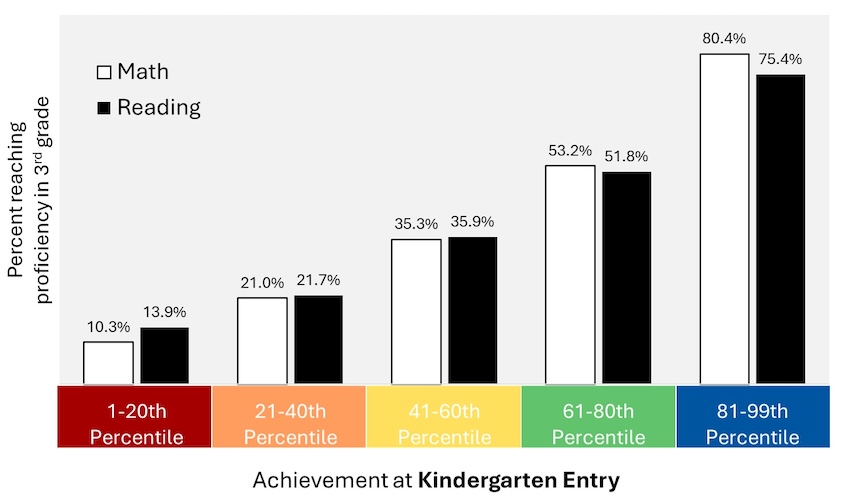
Perhaps most surprising, risk was not limited to students in the lowest achievement group. The majority of students who started kindergarten in the bottom three quintiles failed to reach proficiency by third grade. Even among students entering kindergarten in the 61st–80th percentile range, only about half ultimately met the proficiency benchmark.
These results suggest that educators should think broadly about early identification. While the lowest-achieving students clearly require attention, many students who appear closer to average performance may also need support to stay on track.
For striving students, the window to proficiency closes quickly
We also tracked students who scored in the bottom achievement quintile to third grade to see how their likelihood of reaching third-grade proficiency changed as they moved through grade levels. The results revealed that the probability of reaching proficiency declined dramatically with each grade that passed.
Among students in the bottom quintile at kindergarten entry, approximately 10% reached proficiency in math and 14% in reading by third grade. However, for students who were still in the bottom quintile at the beginning of first grade, those probabilities fell to roughly 5%. By the end of first grade, only about 2% of students in the lowest-achieving group ultimately reached proficiency by third grade.
Odds of reaching third-grade proficiency in math and reading for students in the bottom quintile drop with each term that goes by
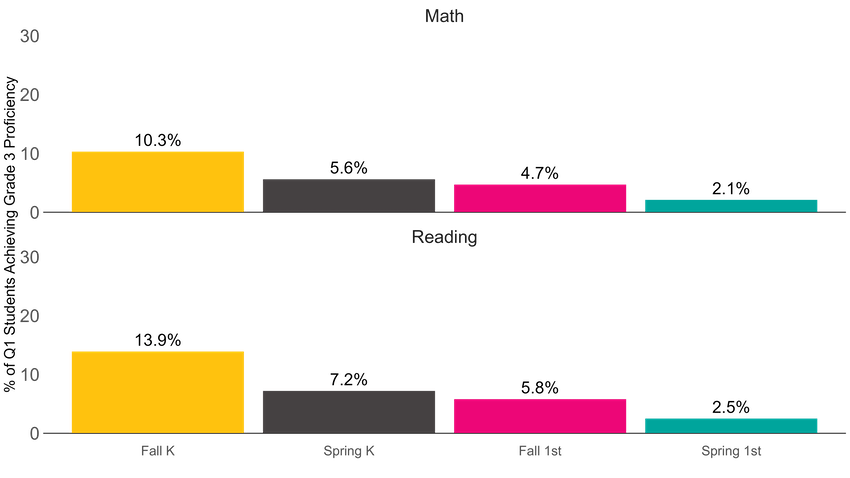 The implication is clear: the earlier educators identify students who need additional support, the greater the opportunity to change their trajectory. Waiting until later grades to provide support may mean that the most effective intervention window has already begun to close.
What this means for schools
For educators, these findings reinforce the value of comprehensive early-grade systems that include screening, progress monitoring, and targeted intervention, specifically those designed to establish a baseline measure on kindergarten achievement.
Universal screening can help schools identify students who may be at risk long before high-stakes accountability measures are administered. Regular progress monitoring allows educators to determine whether students are responding to instruction and intervention. Together, these practices create opportunities to address learning needs while students still have time to make substantial gains.
The findings may be especially relevant as states and districts continue expanding investments in early literacy initiatives. The results also suggest a growing need to apply similar attention to early numeracy, where opportunities for early identification and intervention have historically been less common.
Kindergarten achievement is a signal, not destiny
The most important takeaway from this research is not that students’ futures are fixed when they enter kindergarten. Rather, it is that early achievement provides valuable information that educators can act on.
Students who start behind can and do succeed. But success can become more difficult when challenges persist over time. By identifying students early and providing timely support, schools can create more opportunities for students to reach important milestones, such as third-grade proficiency.