 Educators have all experienced the moment, either as students themselves or while observing their own class: A student has finished reading a passage accurately. Yet when asked to explain what was just read, they struggle. Decoding is happening, but comprehension, stamina, and engagement are missing.
This observation is common in classrooms today and it reminds us of a very important truth: decoding alone does not guarantee understanding.
Fluency can help students move from simply decoding words to reading with enough automaticity and expression to fully understand what they read. An if-then lens can help us better understand what students need next when it comes to their fluency journey.
Why fluency matters more than we think
The Simple View of Reading, which explains that reading comprehension is the product of word recognition and language comprehension, was first presented to the literacy community by Philip Gough and William Tunmer in 1986. Four decades later, the science of reading reminds us that fluent reading supports comprehension. Fluency serves as an important bridge between recognizing words accurately and constructing meaning from text.
When fluency is weak, cognitive load increases for students. This leaves less capacity for meaning-making.
To better understand how a greater cognitive load affects kids, imagine sitting at your doctor’s office. Rather than explaining your diagnosis, your doctor gives you a medical textbook with formal, unfamiliar medical terms and then asks you to summarize your diagnosis. That would be quite taxing. Even if you were able to make out the terminology, the effort required to decode and process the unfamiliar language would leave little mental energy for understanding the message itself. This is what struggling readers experience every day.
Scenario 1: Accurate reading but limited understanding
If students are reading accurately but continue to struggle with comprehension, then fluency may be the missing link between decoding and understanding.
As we analyze assessment data or listen to our students read aloud, we may observe them reading with high accuracy. They may be reading word-by-word, however. If they are doing so, they are not reading with automaticity. As students develop automaticity, they free cognitive resources that can be devoted to making meaning from what they read.
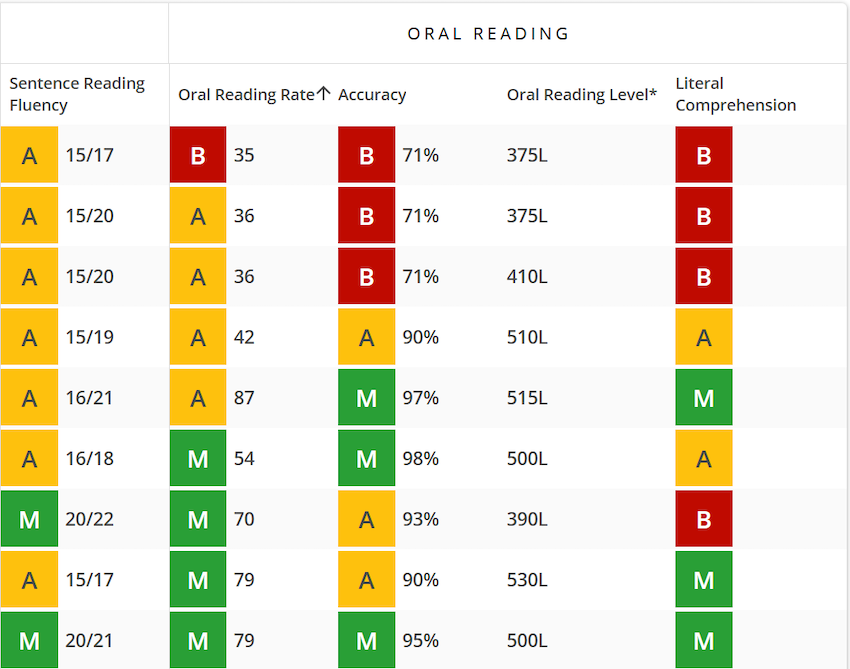
MAP® Reading Fluency™ provides reports that can help teachers quickly see where students are in terms of rate, accuracy, and literal comprehension. These insights can help them quickly identify students who may benefit from targeted fluency instruction. For example, in the screenshot below, a teacher can easily see results for all three of those measures and know which students are meeting grade-level expectations (indicated by a green box with an M in it), which are approaching (yellow A), and which are below (red B).
 Scenario 2: Supporting older readers
If teachers are searching for practical ways to support older readers, then revisiting fluency—not just comprehension strategies—can help uncover the root issue.
Fluency instruction often fades into the background in the upper grades, not because educators don’t value it, but because we assume students have already mastered it. Yet for many struggling readers, fluency gaps persist and continue to affect comprehension across every content area. Without intentional support, those gaps can widen over time.
Instructional strategies educators can focus on to support students include oral reading practice, repeated readings, and modeling prosody (appropriate rate and expression). As a secondary teacher, I was able to help students move through stations to continue to work on these skills. Using age-appropriate texts of interest, I incorporated oral reading practice and repeated readings. I also set fluency goals with students.
For more on how to help students in upper elementary and beyond, see “Reading interventions after grade 4 should focus on both fluency and comprehension” and “5 ways to boost reading fluency for middle and high school students.”
Scenario 3: Connecting the science of reading to practice
If your district is focused on strengthening literacy instruction through the science of reading, then fluency offers a critical connection point between research and classroom practice.
Creating opportunities for students to build fluency skills moves beyond theory and allows teachers to see and hear students reading. Identifying fluency needs requires more than simply listening to a student read once. Educators benefit from tools that provide objective, actionable information about oral reading behaviors over time. MAP Reading Fluency, which earned the National Center on Intensive Intervention’s highest rating, and MAP Reading Fluency with Coach are assessments that support the continuum from phonics to fluency to comprehension.
If you’d like to read more about how MAP Reading Fluency with Coach can reduce stress for apprehensive readers while providing actionable data, I encourage you to read “How AI tutors can lower the stakes for emerging and multilingual readers” by my colleague Kailey Rhodes.
Scenario 4: Building educator understanding through experience
If educators need a deeper understanding of what struggling readers experience, then simulation-based learning can build empathy and provide actionable strategies that can shift instructional decisions.
NWEA offers a science of reading literacy suite accredited by the International Dyslexia Association (IDA). These engaging and interactive workshops empower educators by giving them opportunities to experience simulations so they can better understand the cognitive load struggling readers encounter. Outcomes include:
- Strong connections between student experience and instructional response
- Effective and efficient routines that can be utilized alongside any curriculum
- Strategies educators can use immediately with students to build fluent readers who can read to learn and enjoy reading
While these workshops benefit all educators, they can be especially valuable for upper elementary and secondary teachers who may be less familiar with science of reading practices. Rather than simply explaining the research, the experiences help educators feel the cognitive demands struggling readers face, often leading to meaningful shifts in instructional practice.
From awareness to action
Just because students can decode, it does not mean they are fine. Fluency is not just a “middle” skill; it’s an essential component of being able to read and comprehend text.
As educators, we have countless opportunities to intentionally build students’ fluency through teacher modeling, repeated reading, read-alouds, and purposeful practice using tools such as MAP Reading Fluency and MAP Reading Fluency with Coach.
Fluency cannot become something we stop intentionally teaching simply because students move into the upper grades. Reading fluently influences success in every subject area, not only language arts. Students rely on fluent reading to solve math problems, understand scientific investigations, analyze historical documents, and engage with increasingly complex texts throughout the school day.
Three questions for leaders to consider
As you begin to think about the students you are serving, consider the following questions:
- Are our students reading accurately, but not yet fluently enough to support comprehension?
- Do we consider fluency when diagnosing reading challenges, especially in older students?
- Are we equipping teachers with both the research and practical strategies to address fluency gaps?
Centering the reader experience
When we begin to understand what reading feels like for our students, we recognize that fluency isn’t simply about reading faster—it’s about gaining access to meaning.
As you reflect on your classrooms or your district, which if-then scenario feels most familiar? The answer may reveal the next instructional opportunity for your students. If you’d like to learn more about tools or professional learning that can support fluency instruction, your NWEA representative would be happy to connect.