 I used to be an avid watcher of the show Good Eats. On it, Alton Brown dug into the history and science of food to talk about the best ways to prepare it. Aside from the highly educational and delicious content, I remember Alton using various tools and appliances for unique or even unconventional applications, often quoting the catch phrase, “The only unitasker allowed in my kitchen is a fire extinguisher.”
I am reminded of this again when I think about the various tools we use in math class and how easy it can be to default to thinking about those tools for just one purpose. A clock is for telling time, a ruler is for measuring distance, and a multiplication table is for finding answers to multiplication facts. When we do this, however, we take something that could be used in a wide array of applications and confine it to its most basic (or even boring) use.
Let’s take a few minutes today and push back on that idea, thinking about better ways we could be using the multiplication table in math class.
Pairing the multiplication table with the discovery learning model
For many of us, the multiplication table brings back some prickly memories of memorization. The entire table was handed to us and was intended to be studied like a set of flashcards, a means to an end, a crutch until we were computationally fluent. But if we consider alternative applications of the multiplication table, we can begin to reframe it as less of a single-use tool and more of a bridge into new ways of thinking.
I wrote previously about the discovery learning model and how it can increase not only student engagement but also conceptual understanding. Applying those student-centric discovery practices with your instruction using the multiplication table can build a smoother transition to and through the vast realm of multiplication.
Tips for grades 2–4
When looking for more effective uses of the multiplication table in the earlier grades, I recommend the following.
Start with a blank table
Before students even look at the multiplication table as a whole unit, there is great value in having them fill it in themselves. You might even go as far as not calling it a multiplication table at first.
Especially in grades 2 and 3, beginning with a blank table reinforces skip counting strategies and helps students naturally see connections between the different rows and columns of skip counts on their own. Allow this natural curiosity to build the first pathway into multiplicative thinking and the relationships between numbers beyond addition.
Define the table
Once your students have completed the table via skip counting, ask them what they notice about the lists of skip counts. Direct them organically to see that the numbers across a given row also match the numbers going down the corresponding column.
Next, have your students label the left side of each row and the top of each column with the number skip counted in that row or column. That will take your skip count lists to a formal multiplication table layout. Show students how a product can be found using these new row and column headers.
There are so many possible observations and theories for students to make about how the table works once it’s been defined. Some of these are listed below, but don’t neglect the natural paths your students may find and want to explore together, too.
Explore the commutative property of multiplication
Direct students to see that the table is actually mirrored over the diagonal line connecting 1 × 1 and 10 × 10, as shown in the example below.
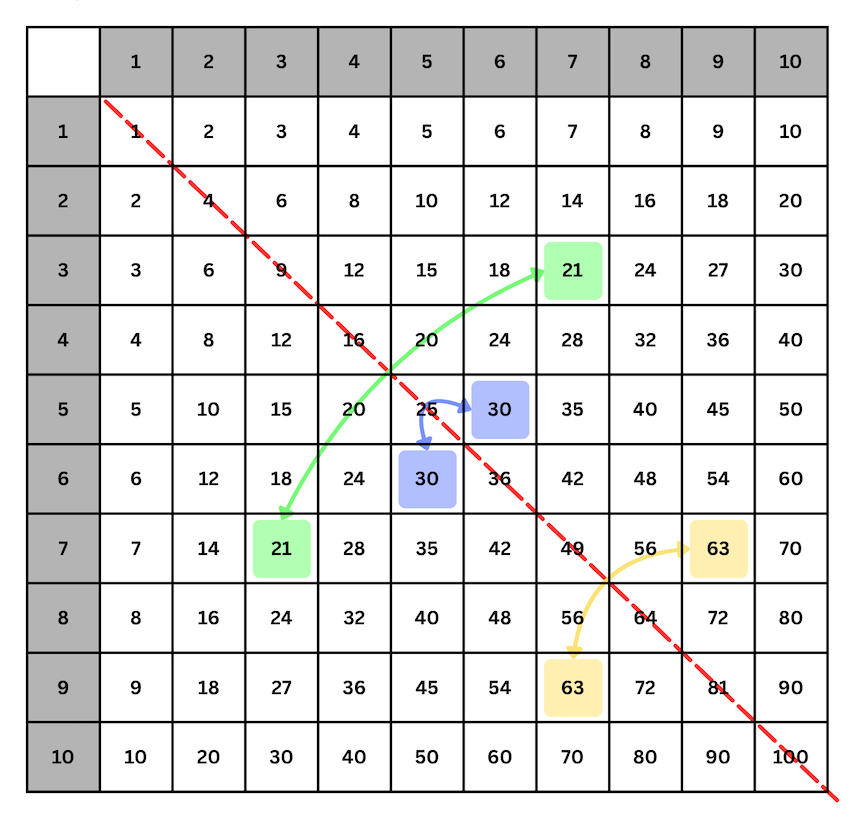 Wonder with students about why this is and allow the class to theorize what is happening. Point out some specific examples of products mirrored across the diagonal line you draw in, like 21, 30, and 63.
Also allow space for students to conclude that cells with the same product indicate the same factors but in reverse order. For instance, 21 is the product of 3 × 7 and also of 7 × 3. Once discovered, give this phenomenon a formal name: the commutative property of multiplication.
Investigate the identity property of multiplication
Have students study the first column and first row of the multiplication table. Ask what they notice about these products. Guide them to realize that multiplying a number by one gives a product equivalent to the original factor. Said another way, multiplying by one maintains the value of the number.
Once discovered, give this phenomenon a formal name, too: the identity property of multiplication.
Build area models
Give students opportunities to physically draw and color on the multiplication table to find patterns. This can help you introduce the connection between area models and multiplication. Starting in the top left corner, have students shade in a rectangle of any width or length, like in the example below.
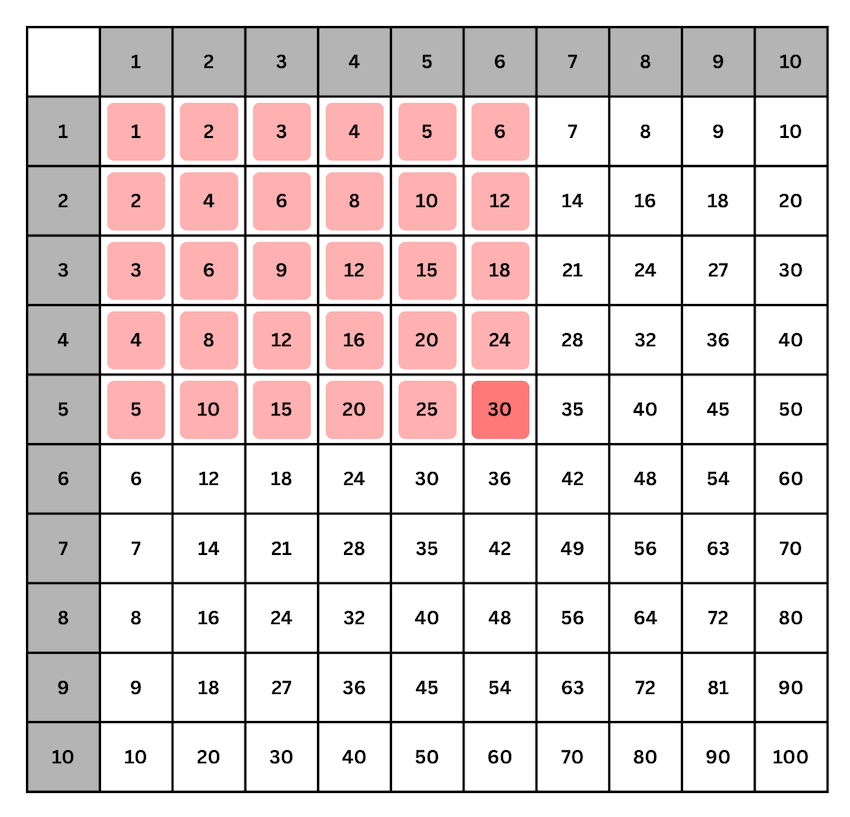 Direct them to realize by counting the squares shaded that the bottom right number (the product of the two rectangle’s dimensions) is the same as the area of the rectangle they drew (given side lengths of one that are as long as the cells on the table). But don’t stop there! Have students consider what these numbers represent in terms of the area model. Ask questions to help them generalize their thinking, like, Why does the bottom right number always give us the area of any rectangle we draw?
Notice relationships between factors
Direct students to a row or column of a greater number, like the row for eight. Have them identify which numbers from that row also appear in another row. Theorize together about why products like eight and 16 also appear in the rows for two and four.
Repeat the process with numbers from other rows or columns. Then allow students to try new combinations to connect the rows and ask questions about situations that don’t align as well. For example, Why do nine and 27 from the nines row only show up in the threes row and not the fours or fives row?
Analyzing relationships between factors strengthens the connections students can make to commonly used denominators of fractions, too. For instance, it can help them understand the relationships between halves, fourths, and eighths or halves, thirds, and sixths.
Laying this groundwork in emphasizing relationships between numbers will improve all aspects of a student’s mathematical fluency when it comes to solving more advanced multiplicative scenarios in later grades.
Introduce mathematical terminology
Help students build their math vocabulary during all your exercises with the multiplication table. For example, when looking for patterns among factors, model using formal terminology like “common multiples” for students by starting with statements about what two factors have “in common.”
Find the mode
Continuing on the coloring route, have students color code each product in a multiplication table by determining how many times that product appears.
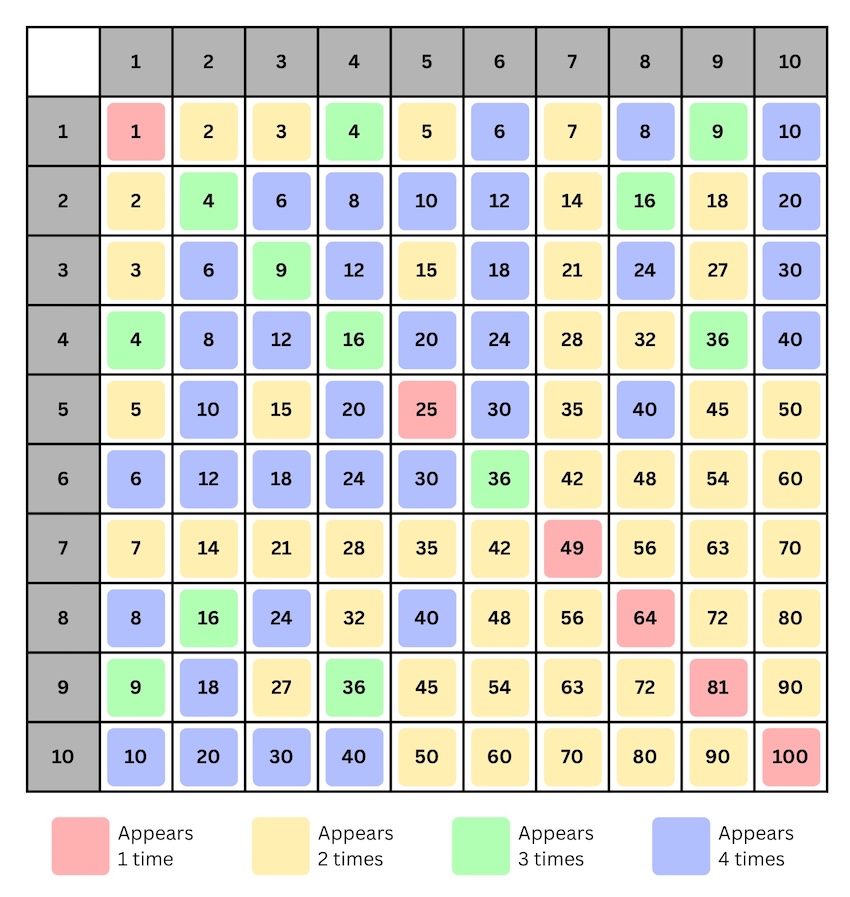 From this exercise, even more patterns are revealed along with juicy questions the class can dig into, like:
- Which numbers appear most on the table? What do these numbers have in common?
- Why don’t the row and column of sevens have any numbers with more than two appearances on the table?
- What’s happening on the diagonal line from 1 × 1 to 10 × 10?
- What’s happening in the cells where a prime number is multiplied by a prime number?
- Why is 48 only showing two instances on the table. Doesn’t it have more factors than that?
Tips for grades 4–8
Here are some ideas for ways to work with the multiplication table with students in upper elementary and middle school.
Practice working with primes and composites
Have students identify examples of numbers that appear multiple times on the table (or complete the coloring activity mentioned for younger students above). Then have them consider what would happen if we extended the table to the right and down. Which numbers would remain at just one or two instances? The majority would move to three or more since they are composed of at least three factors, that is, they’re composite numbers. Ask students how this exercise helps us determine what the prime numbers are and where they would live on the multiplication table.
Also consider having a special discussion about one and zero. One is the only number with a single factor and zero is the only number with an infinite number of factors. Since neither meets the definitions of “exactly two” or “more than two” factors, one and zero are neither prime nor composite.
Talk about divisibility
Naturally, discoveries of patterns within the multiplication table lead to more formalized divisibility rules.
By observing a set of multiples for a given number, your students can start to generalize the requirements for a number to be divisible by a given factor. Encourage them to use relationships between numbers to make more meaningful leaps in conceptual understanding. For example, ask them what they notice about every product in the sixes row. Guide them in noticing that they are all even and, therefore, divisible by two. They are all also multiples of three and, therefore, divisible by three. Follow up by asking, Does that mean divisibility rules for certain factors could be composed of the divisibility rules of the numbers that factor is divisible by? That’s worth exploring further.
Point out near perfect squares
Have students notice that the perfect squares (the diagonal down the table) are formed by multiplying a factor by itself. Next, direct their attention to the products that are one away from these perfect squares (diagonally in the other direction), as shown on the table below.
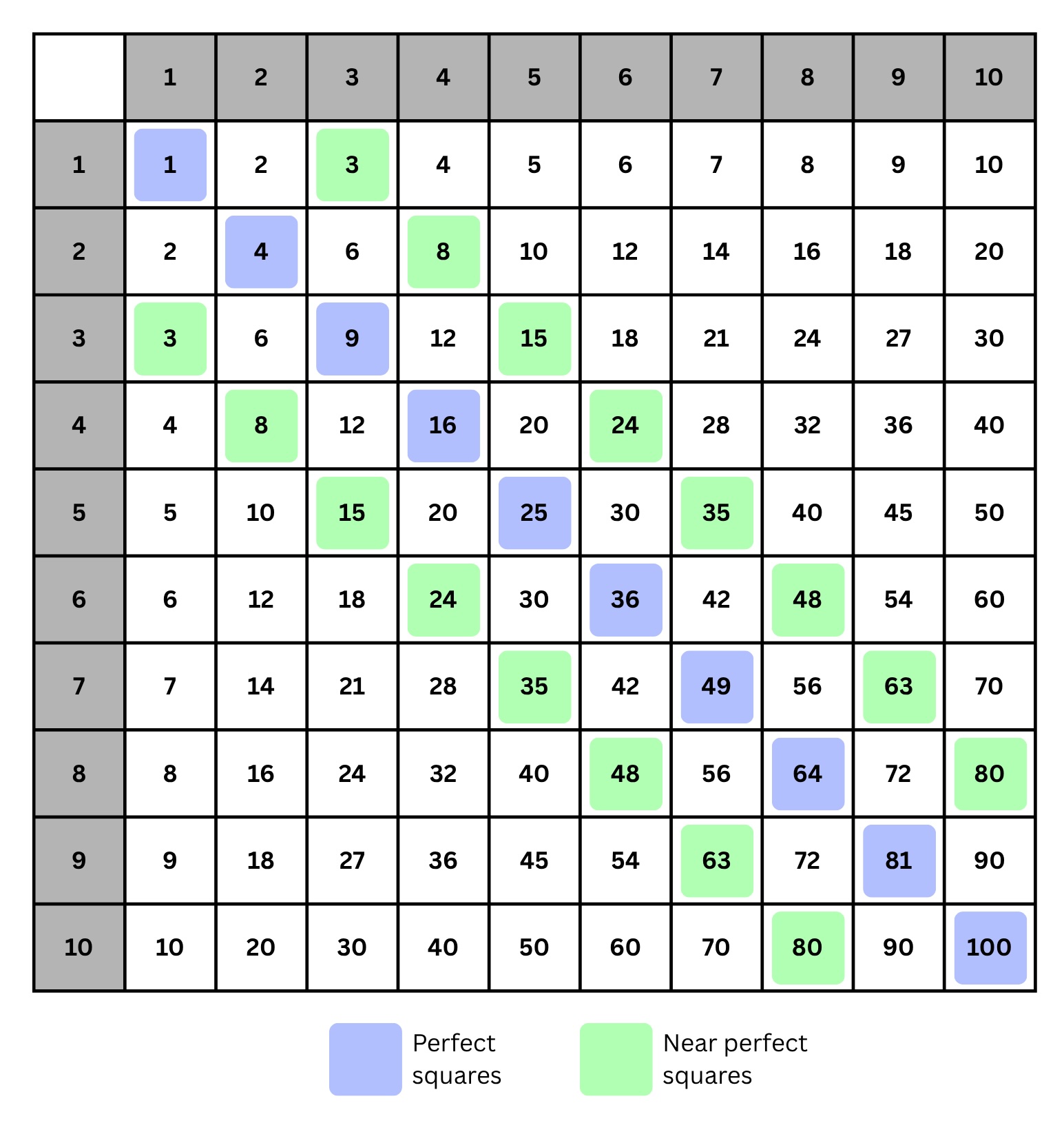 Ask the class, What larger conclusion can be drawn about multiplying two numbers that have a difference of two? Could you use this reasoning to quickly find the product of 19 × 21? This and so many other patterns are just waiting to be discovered.
Notice firsts
Interestingly, the table could also be used to determine firsts. For instance, the first composite number is four; it has three factors. What, then, is the first number with four factors? And the first with five? Continuing from there, have students estimate where they would find the next first in the list and consider how that pattern is growing.
Also consider asking your class the following questions:
- Why is the first number with six factors less than the first number with five factors?
- What do the first numbers with three, five, and seven factors have in common? Why is that?
- How does the number of factors relate to the prime factorization of a number?
- Can you use the prime factorization of a number to find out how many factors a number has?
- Which number would have more factors, a number with the prime factorization 2 × 2 × 2 × 2 × 2 or a number with the prime factorization 2 × 2 × 2 × 2 × 3? What about for 2 × 2 × 2 × 2 × 5?
Challenge with set theory
Though not formally required by most state math standards, set theory is a powerful way to build students’ exposure to and comfort with multidimensional relationships between numbers as early as elementary school.
The multiplication table contains many different number sets, including sets like multiples of eight, perfect squares, numbers divisible by three, even numbers, and prime numbers. In application, it’s highly beneficial for students to move beyond comparing single values to comparing sets of numbers. This can lead to deeper reasoning about series of numbers, which ultimately promotes the transition to the use of variables and functions.
Ask students specific questions and have them model their thinking using Venn diagrams or other reasoning to support their justifications. Here are a few to consider:
- Which products appear in both the multiples-of-eight and divisible-by-three sets?
- Why is the multiples-of-eight set completely contained in the multiples-of-four set (also known as a subset)?
- Beyond odds and evens, can you name two sets that do not share any values (known as elements)?
- Are there two sets that only share one element?
Get more from multiuse tools
Ever since I watched Good Eats all those years ago, I still don’t like buying kitchen appliances or tools that only have a single use. And my interactions with mathematics are no exception.
Seeing how powerful and versatile a tool like the multiplication table can be, it’s almost silly to put it back in the drawer until we need it to look up the answer to a math fact. Not only does a tool like this build a bridge into a new mathematical concept, but it also provides countless ways for students to interact, develop theories, critique the reasoning of others, and develop meaning. So pull your multiplication table out, start a conversation, suggest something about it that makes you wonder, and make a profound discovery together this school year.
And don’t stop there. What other tools are hiding in your manipulatives cabinet that are dying for a second, third, or even fourth use case? Where could the tools you use to scaffold problem solving actually be leading the way into deeper conceptual understanding for your students?