 One of my biggest regrets is not being able to speak another language with any level of fluency. Despite taking six years of Spanish in middle and high school, I can only haltingly put together a sentence or pick out a few random words in a Spanish song.
When you are truly fluent in all aspects of a language—reading, writing and speaking—you can not only speak and understand it, but you can also interact with it at a subtle level. With true fluency comes the ability to pick up on nuance and culturally specific language, like idioms. When you are fluent, your deep vocabulary knowledge and understanding of the language’s structure allow you to construct complex sentences that can convey subtext, evoke humor, and more. Mathematical fluency is similar.
Understanding mathematical fluency
“Mathematical fluency” is a term that gets tossed around a lot. For many people, mathematical fluency is equated with knowledge of basic facts, standard algorithms, and speed. Although these are aspects of fluency, I like to think about fluency in mathematics more like fluency in a language. Although a fluent speaker of a language can likely speak more quickly than a non-fluent speaker, speed is but a single measure of fluency. I could probably read a sentence in Spanish at a decent rate, but I may not fully understand it, and I likely couldn’t construct a similarly complex sentence myself.
One can engage with mathematics at a very simple level, understanding some basic vocabulary of math without fully grasping the structures and relationships that hold the discipline together. Knowing your basic facts in math is a little like being able to conjugate verbs in a language: while both are important to engaging more deeply, the real key to being fluent is being able to flexibly use this knowledge in support of more complex ideas.
Moving past speed and memorization
Mathematical fluency is most often equated with speed. However, as my colleague Lindsay Dworkin stated in “What does it actually mean to be fluent in math?” “speed can be a byproduct of fluency, but it isn’t the goal on its own.” So, let’s start by reframing the idea of fluency.
The National Council of Teachers of Mathematics describes fluency as “the ability to apply procedures efficiently, flexibly, and accurately; to transfer procedures to different problems and contexts; to build or modify procedures from other procedures; and to recognize when one strategy or procedure is more appropriate to apply than another.”
What does this mean exactly? Mathematical fluency emerges when students can use and apply what they know in flexible ways. A fluent math student doesn’t just know a procedure; they understand when it applies, when it is or isn’t the most efficient approach, why it works, how it connects to other ideas and procedures, as well as alternative approaches. Students who have achieved mathematical fluency can adapt their thinking when a problem looks unfamiliar, much like a fluent language speaker can rephrase an idea in multiple ways to convey the meaning required for the specific context. Researchers Jon Star and Colleen Seifert equate skillful execution of a procedure both with using the procedure “rapidly, efficiently, with minimal error, and with minimal conscious attention” and with “being able to select appropriate procedures for particular problems, modify procedures when conditions warrant, and explain or justify one’s steps to others; that is, to execute a procedure thoughtfully or deliberately.”
Instead of linking mathematical fluency to speed, it may be better to relate fluency to attributes like efficiency and flexibility. Algorithms are often equated with efficiency and held up as the culmination of a student’s understanding of a skill. Because competency with an algorithm often lies at the end of a mathematical progression within a standard set, it has come to be seen as the ultimate goal, superseding all learning that came before. Know how to line numbers up by place value and regroup using the standard algorithm to add and subtract? Great! Now you can forget all the other approaches you learned like partial sums, open number line, making a ten, and counting on to add.
While algorithms can represent an efficient way to solve a problem in many cases, when you are fluent in the structures of math, such as the base ten system, you may recognize more efficient ways to approach a problem. Take 4,395 – 9.25. You can solve this using the standard algorithm, but as you can see below, things get complicated pretty quickly as multiple place values require regrouping.
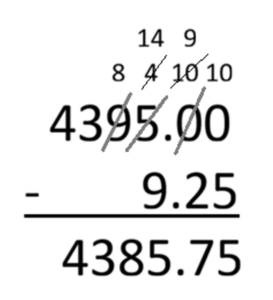
If one has comfort and fluency with numbers, you might recognize that it is faster and easier to subtract 10 from 4,395 and then add back the extra 0.75 that was taken away by subtracting 10 instead of 9.25.
Mastering an algorithm, then, should be seen as adding another powerful tool to a student’s toolbox, not as a reason to throw out all the old tools in favor of one single new tool.
The roles of fluency and conceptual understanding
Procedural fluency and conceptual understanding are typically both cited as important aspects of mathematical proficiency. Pursuing conceptual understanding, procedural skills and fluency, and application with equal intensity are one of the key shifts of the Common Core. The National Academy of Science’s publication Adding It Up: Helping Children Learn Mathematics also identifies procedural skill and conceptual understanding as two of the five strands of mathematical proficiency. Despite frequently being described as interwoven strands, procedural fluency and conceptual understanding are often treated as separate and disconnected. Let’s dig more into the relationship between these key components of math.
Researchers James Hiebert and Patricia Lefevre associated procedural knowledge with the idea of knowing how to do something and conceptual knowledge with knowing why you are doing it. Adding It Up talks about conceptual understanding as referring to “an integrated and functional grasp of mathematical ideas. Students with conceptual understanding know more than isolated facts and methods. They understand why a mathematical idea is important and the kinds of contexts in which it is useful. They have organized their knowledge into a coherent whole, which enables them to learn new ideas by connecting those ideas to what they already know. Conceptual understanding also supports retention. Because facts and methods learned with understanding are connected, they are easier to remember and use, and they can be reconstructed when forgotten.”
The interconnected understanding of math that conceptual understanding builds helps support both retention and flexible problem solving. When students only know isolated procedures, they may not know what to do next if the expected procedure doesn’t work. In some cases, they may simply apply the procedure regardless and accept the answer as correct even when it does not make sense in the context of the problem.
Fluency and conceptual understanding go hand in hand
Hype over the so called “math wars” and the “science of math” movement tend to paint educators as being on one side or another. Traditionalists are depicted as elevating procedural skill and fluency as more important than conceptual understanding, which is painted as the realm of the reformer. However, the Center on Reinventing Public Education’s recent report “Navigating the math wars” highlights the fact that the two sides are really more in agreement than is depicted.
Often the argument is not over which is more important, but whether students should focus on procedures and fluency or conceptual understanding first. Research suggests there is a bidirectional relationship between conceptual knowledge and procedural fluency, with improvement in one area supporting improvement in the other. The National Academies book How Students Learn: Mathematics in the Classroom states, “Using concepts to organize information stored in memory allows for much more effective retrieval and application. Thus, the issue is not whether to emphasize facts or ‘big ideas’ (conceptual knowledge); both are needed. Memory of factual knowledge is enhanced by conceptual knowledge, and conceptual knowledge is clarified as it is used to help organize constellations of important details.”
Without conceptual understanding, mathematical fluency is reduced to merely being about speed and automaticity, not about flexibility and efficiency. When students lack deep conceptual understanding, fluency becomes fragile. It works only when problems look familiar and falls apart when they do not. With conceptual understanding, mathematical fluency becomes flexible, durable, efficient and transferable. Dan Meyers gives several good examples of how fluency without conceptual understanding can actually slow students down in his article “What does fluency without understanding look like?”
Fluency is about more than just facts and procedures
True mathematical fluency extends beyond the realm of facts and procedures. Mathematically proficient students exhibit multiple types of fluency, including conceptual, strategic, representational, and mathematical language fluency. These types of fluency are actually spelled out in most college-and-career ready standards, sometimes within the content standards, but more often and more explicitly in the mathematical process standards.
Let’s take a look at some of the ways students can exhibit fluency and how each of these types of fluency shows up in the process standards.
Conceptual fluency
Conceptually fluent students have a strong understanding of how mathematical ideas relate and connect. This network of understanding the relationships and structures within math supports flexible problem solving. Conceptual fluency helps students understand why multiplying a whole number by a fraction results in a product that is less than the whole number, for example, or why dividing a fraction into more parts results in each part being smaller.
Virginia’s Mathematics Standards of Learning require that they “build upon prior knowledge to relate concepts and procedures from different topics within mathematics and see mathematics as an integrated field of study. Through the practical application of content and process skills, students will make connections among different areas of mathematics and between mathematics and other disciplines, and to real-world contexts.”
Strategic fluency
Strategically fluent students can choose and alter strategies and solution approaches as they attack novel problems. They have multiple tools in their tool chest and don’t need to rely on reproducing a single memorized solution path. Strategic fluency helps a student decide whether the traditional algorithm is the most efficient approach. When working with an equation like 3(x + 4) = 21, a strategically fluent student will consider whether it is more efficient to distribute first (3x + 12 = 21) or divide first (x + 4 = 7).
The Common Core Standards for Mathematical Practice describe mathematically proficient students as those who “start by explaining to themselves the meaning of a problem and looking for entry points.” These students “make conjectures about the form and meaning of the solution and plan a solution pathway,” “consider analogous problems, and try special cases and simpler forms of the original problem,” “monitor and evaluate their progress and change course if necessary,” “check their answers to problems using a different method,” and “continually ask themselves, ‘Does this make sense?’”
Representational fluency
Students who have representational fluency can easily move between different mathematical representations, such as equations, diagrams, tables, and graphs. They are able to select the best representation for a given purpose or situation and determine which form is best for explaining their mathematical ideas. When solving a problem about comparing two cell phone plans with different initial costs and different monthly rates, for example, having representational fluency can help students determine whether graphing the equations is more efficient than making a table.
Florida’s Mathematical Thinking and Reasoning Standards specify that students, “represent solutions to problems in multiple ways using objects, drawings, tables, graphs and equations,” “express connections between concepts and representations,” and “choose a representation based on the given context or purpose.”
Mathematical language fluency
Students who are fluent in the language of mathematics can explain, adjust, and defend their mathematical ideas in ways that are understandable to others. They know the textual, visual, and symbolic vocabulary of the discipline and can determine which combination will best express their thinking.
Texas’s mathematical process standards call for students to both, “communicate mathematical ideas, reasoning, and their implications using multiple representations, such as symbols, diagrams, graphs, computer programs, and language” and “display, explain, or justify mathematical ideas and arguments using precise mathematical language in written or oral communication.”
Building confident mathematicians
In thinking back to the idea of language fluency, one of the other hallmarks of a fluent speaker is confidence. The more you know of a language, the more experience you have with the vocabulary, the structure, and the cultural components, the more confident you are in your expression of it. The same is true for mathematics. Students who have true mathematical fluency also tend to be confident mathematicians. They are willing to explore and experiment with ideas and solutions because they have a rich bank of understanding to fall back on if their first ideas or approaches aren’t successful.
If we want students to truly and deeply engage in mathematics—to reason, problem solve, persevere, and apply what they know in unique situations—we need to broaden what we value as fluency. When we do, we stop rewarding speed as the only measure of proficiency and we create opportunities to equip more students to be capable mathematical thinkers.
Looking for more resources on supporting mathematical fluency beyond memorizing facts and procedures? Check out the links below.
- The Development of Arithmetic Concepts and Skills: Constructing Adaptive Expertise Chapter 1, “The development of adaptive expertise and flexibility: The integration of conceptual and procedural knowledge,” by Arthur J. Baroody, provides both a historical and research perspective on the procedural knowledge vs. conceptual understanding debate.
- “Eight unproductive practices in developing fact fluency” Although this article is only accessible for NCTM members, co-author Jenny Bay-Williams discusses ways to teach basic facts fluency that support reasoning and sensemaking instead of just focusing on memorization in the following podcast episodes: “Fluency 101: Productive ways to build fluency with basic facts” and “Think, talk, choose: Math routines that grow fluency.”
- “Fostering mathematical fluency: Reviewing strategies for building strong foundations” This article details strategies and approaches for developing what the authors describe as the “essential components of fluency”: conceptual understanding, procedural proficiency, strategic competence, and adaptive reasoning.
- “How we solve America’s math crisis: A systemwide approach to evidence-based math learning” This report from the K12 Coalition discusses systemwide changes that can support improved learning in mathematics and includes a section on instructional practices and how leadership can support teacher moves for balancing procedural skill and fluency with conceptual understanding.
- “Math implementation webinar session #4: Fluency to flexibility” This webinar by Montana’s Office of Public Instruction, and part of their math implementation webinar series, discusses the shift in their standards from talking about students working fluently to them working flexibly, accurately, and efficiently. Although this focuses on the Montana math standards, it highlights how fluency comes through in a standard set.
- “Mathematical proficiency: The five strands” This NCTM resource highlights teacher and student actions that can support the five strands of mathematics proficiency.
- “Navigating the math wars: A practical guide to the divides and debates influencing math instruction” In addition to digging into the math wars debate over a fluency first vs. conceptual understanding first approach, the Center on Reinventing Public Education’s guide shines a spotlight on the idea of cognitive load theory. This theory looks to balance the explicit instruction often associated with a facts-first approach vs. the more inquiry-based, concepts-first approach, seeking “not to pit these perspectives against one another, but to ask how they can be brought into better alignment with each other.”
- “Procedural fluency in mathematics” and “Fluency: Simply fast and accurate? I think not!” These two resources explain NCTM’s stance on procedural fluency.