 Remember classroom round-robin reading, counting the paragraphs before it was your turn? I remember sitting in my fifth-grade history class with Ms. Lofton, whose stuffy nose made me hear my name when she called on one of the three Taylors. I was a strong reader and always wanted a long, challenging paragraph to tackle.
Fast-forward to adulthood. In my work as a teacher and here at NWEA, I’m surrounded by people who also counted the students before them to know which paragraph they’d read. But unlike me, many prayed for a short paragraph and a quick delivery from read-aloud purgatory.
For many students, especially those still developing foundational reading skills, those moments feel less like learning and more like exposure. For students with dyslexia—an estimated 15–20% of readers—it can feel like a high-stakes guessing game. And for many multilingual learners, it can feel like the curviest curve ball while standing at the plate under a spotlight.
With such public stakes, anxiety can override the learning for all these kids.
When reading becomes performance
Think about the common moments when reading happens in front of others:
- Cold-calling round-robin reading
- Timed fluency checks
- One-on-one intervention sessions
- Group tutoring huddles
- Bedtime reading at home
Even in classrooms and families grounded in care, reading often happens in front of stakeholders—teachers, peers, parents—who, despite their attempts at neutrality, care deeply about the reader’s improvement. Hope is present. Approval is present. And evaluation—sometimes frustrated, sometimes subtle, sometimes subconscious—is present, too.
When the emotional stakes rise, some readers develop what I think of as “itchy reading behavior.” They seem slightly allergic to the experience. You might notice students:
- Guessing words from the first letter
- Rushing through sentences
- Asking to go to the bathroom right before their turn
- Watching adult facial expressions more than the text
Here’s the real problem: Anxiety doesn’t simply make reading uncomfortable. It interferes with reading development.
Anxiety earmuffs
Have you ever sung karaoke in front of people and suddenly felt anxious to sing a song you’ve nailed alone in the car? It’s not new news: fear of negative evaluation can change how we perform.
For multilingual learners reading in a second (or third or fourth) language, that pressure can multiply quickly. In 1982, linguist Stephen Krashen introduced the concept of the affective filter in second language acquisition theory. His insight was that emotional factors—things like anxiety, confidence, and motivation—can influence how effectively learners process language. When this “affective filter” rises, listening lowers. In my words? Language input struggles to get through “anxiety earmuffs.”
It’s not that students cannot decode the words or learn them on another day; stress just makes it harder to process and internalize what they’re reading in the moment.
We teachers can likely agree that this emotional experience affects all learners, regardless of how many languages they speak. So the questions become, how can we lower that affective filter? How can we remove the earmuffs? And how can we make the reading environment less emotionally charged so our learners’ brains can receive what they’re reading?
A safe, research-backed place to swing (and miss and swing again)
In one study from the University of Chicago’s Human-Robot Interaction Lab, children reading aloud to a robotic companion showed lower observable anxiety than when reading to an adult. Researchers noted these children were more willing to persist through mistakes when the “listener” did not display evaluative facial expressions.
A recent study published in the Arab World English Journal also explored how AI tutors affect language learning motivation and anxiety. Researchers found that learners reported lower anxiety when interacting with AI tutors, largely because the system provided feedback without social judgment. While this study focused on adult language learners, the findings echo earlier work in reading technology. Carnegie Mellon’s Project LISTEN, an early intelligent reading tutor, showed measurable gains when students practiced oral reading with computer-based feedback, for example. The system allowed repeated, individualized, low-pressure practice—particularly benefiting students who began with lower reading proficiency.
Think of a baseball player practicing with an automatic pitching machine. The machine doesn’t cheer, flinch, sigh, look disappointed, or tell you, “Good job!” on one hit and remain silent on the next. It simply delivers the next pitch. An AI reading tutor functions similarly. It allows students to take more swings—more reading attempts—without social consequence. When students feel safe enough to be imperfect, they practice more. When they practice more, they improve. And when they improve, anxiety eases and learning sticks.
The value of AI tutoring, then, isn’t just technological—it’s emotional. While there won’t be an automatic pitcher in the game or an AI tutor during every authentic reading task, rehearsal without judgment can build the confidence required for real performance because it changes the conditions under which practice happens.
AI tutoring with MAP Reading Fluency and Coach Maya
All of this research points to an important truth: reading is emotional, not just academic. MAP® Reading Fluency™ is grounded in that understanding.
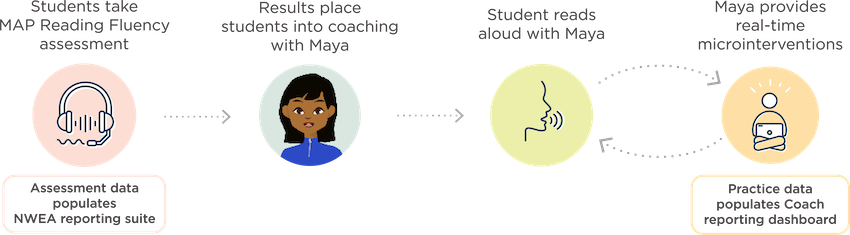 Students begin by taking the assessment, which uses results to place students on personalized tutoring pathways with Coach Maya, an AI-powered reading coach. Maya listens carefully as students read aloud—in English or Spanish—and provides real-time microinterventions based on what she hears. These interventions target key reading components, including:
During tutoring sessions, Maya pauses to provide feedback, show short videos of human speakers, highlight patterns in student reading, and—crucially, when it comes to saving teachers time—suggest what to read next. The goal is not simply to correct errors, but also to create more opportunities for low-stakes, supported practice. For students whose anxiety might otherwise limit their willingness to try, that change in conditions can make a real difference.
Let’s be clear about AI’s place in the game
AI tutoring doesn’t remove challenge; it untethers practice from game-day consequences. Live read-alouds—with teachers, peers, and family members—are still essential. They are the real game. But practice always precedes the real game, and that practice is more fluid when mistake-making feels safe.
For teachers, AI tools can act as the batting cage before the game. It’s the low-stakes warm-up before live reading, the rehearsal before a performance.
For administrators and district leaders, AI tutoring functions as a capacity multiplier, not a staff replacement. These tools can:
- Increase practice opportunities within limited intervention time
- Reduce friction during homework routines at home
- Support multilingual learners navigating language anxiety
- Address emotional barriers to reading, not just skill gaps
What AI cannot replace is equally important:
- Teacher-led instruction
- Responsive teaching
- Relationships and encouragement
- Professional judgment
- Opportunities for readers to show off their skills to those who root for them
Teachers remain the difference makers. AI simply helps move some of the practice out of the spotlight.
Put me in, Coach
I wanted the long paragraph in Ms. Lofton’s class because I believed I could handle it. That belief didn’t come from nowhere. It came from having enough opportunities to practice, make mistakes, and try again without fear.
Learning to read will always involve challenges. But the fear that sometimes surrounds reading? Let’s try to reduce that part. Because when fear decreases, practice increases. And when practice increases, readers take bigger swings.