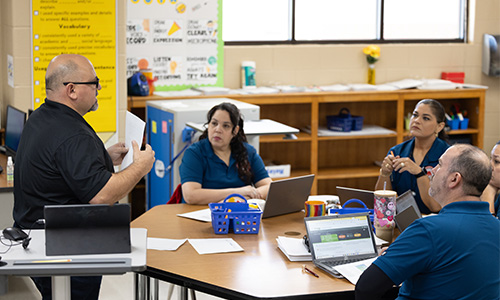
 In classrooms today, teachers know there could be as many different learning needs as there are faces in front of them. Because achievement gaps are tough to close and students across Tiers 1, 2, and 3 all require different types of scaffolding and opportunities, educators are turning to structured, systematic approaches to make the task of delivering personalized instruction more manageable. One approach that’s gaining momentum is WIN time, a strategic intervention block that provides a practical solution to the challenge of personalization at scale.
WIN is an acronym for “What I Need,” and WIN time represents a more inclusive turn away from traditional student intervention strategies, which tend to interrupt core instruction and single out students in need of extra support. Instead, WIN time creates a protected period where all learners—whether they need remediation, reinforcement, or acceleration—receive targeted support.
In this article, you’ll get an overview of what WIN time is, where it came from, why it works, and how schools are implementing it successfully with the support of assessment data from tools like MAP® Growth™ and MAP® Reading Fluency™.
What is WIN time in education?
The main thing to know about WIN time is that it’s meant to be an everyday, inclusive, and flexible activity. Let’s take those qualities in order.
First, WIN time is a dedicated block for daily intervention time in schools—often 30 minutes, but sometimes up to an hour—that’s specifically designed for personalized academic support. During this period, students receive differentiated instruction tailored to their current learning needs, whether that means skill-based intervention, enrichment activities, or targeted practice.
As for inclusivity, Beth Praska, a senior professional learning consultant at NWEA, explains that WIN time supports students across the achievement spectrum—from those working to meet grade-level expectations to advanced learners ready for more challenging content. “In meeting every student where they’re at, WIN time really fosters equity,” says Beth. “It gives them time to dig into their work and get what they need at that moment.”
Finally, a big part of WIN time’s appeal is its flexibility, which is also what makes it so effective. Schools can customize these learning blocks to include small groups, peer tutoring, digital learning opportunities, or independent work, depending on students’ needs and available resources. But it’s important to note that even with a flexible approach, there’s a lot of purposeful planning—based on timely assessment data—happening behind the scenes.
The origin of WIN time
WIN time in education has its roots in two frameworks: response to intervention (RTI), a system for early identification and support of learners needing additional support, and multi-tiered system of supports (MTSS), a proactive and data-driven approach to meeting diverse learning needs. These evidence-based approaches emerged from the recognition that schools needed systematic ways to identify these learners early and provide intensive, tailored scaffolding.
Building on this foundation, WIN time evolved for an increasingly common classroom scenario in which growing numbers of students need intervention help—a reality that flips the familiar RTI/MTSS pyramid upside down. Since traditional intervention models aren’t always able to meet this growing demand, WIN time emerged as a solution that could support more learners simultaneously while preserving their access to core instruction.
For Beth Praska, the necessity of a program like WIN time in translating theory into practice is common sense. “If you have an MTSS system that’s identifying student needs, then you have to have a system that provides an opportunity to support those students—and it can’t always just be a pull-out by the Title 1 teacher because there’s not enough of them,” she says. “That’s why WIN time and MTSS go hand in hand.”
A winning strategy: Why and how WIN time works
Academic growth and social-emotional development are not only closely related—they also synergistically build on and enhance each other. When WIN time is working as it should, teachers can see that students gain several interconnected benefits that help them grow and thrive:
- Agency and engagement. When students take part in WIN time, they become active rather than passive participants in their learning journey. “Students understand where they need to be and what they need to be working on,” Beth observes. Students gain greater confidence and control over their learning path and pace, while at the same time building competence through appropriately challenging work. Research has identified autonomy, competence, relatedness, and relevance as essential elements that drive student engagement—and WIN time directly addresses all four.
- Equity through differentiation. WIN time ensures that every student has access to learning opportunities that fit their own mix of skills and challenges. Rather than a one-size-fits-all approach, students work within their zone of proximal development (ZPD), that “sweet spot” where they’re challenged to complete tasks that are ambitious but achievable.
- Reduced stigma. Whereas traditional pull-out programs can bring unwanted attention to learners in need of support, WIN time helps level the playing field. “There’s a lot going on during WIN time, and that means that individual students feel less stigmatized,” Beth explains. When teachers work with different groups and students shift around for various purposes, students see that everyone is engaged in their own personalized learning path.
- Meaningful response to assessment. Simply put, WIN time creates space to act on what assessment data reveals. This includes both interim assessment data from tools like MAP Growth and MAP Reading Fluency, as well as formative data from daily instruction. “So often, we collect the data and we know what we need to do for students, but we just don’t have an opportunity to meet them where they are,” Beth notes. WIN time provides that immediate response to support students.
How are districts using WIN time?
Because WIN time is both flexible and adaptable, districts can develop their own versions of it to accommodate their specific school contexts. Here are the most common implementation models:
- Skill-based and flexible grouping. Using assessment data, teachers create flexible groups based on the specific areas in which students need to build or refine their skills. These groupings change frequently based on the latest data or teacher observations, ensuring that students receive assistance precisely matched to their current needs. Beth notes that the fluidity of learning groups is a key feature of WIN time. “It doesn’t stay the same all year—it has to keep evolving,” she emphasizes. “That doesn’t mean you’ll change things up every day, but at least once a week, you’ll want to adjust and rethink what the students need at that time.”
- Teacher-led small groups. When grade levels have multiple teachers, they can divide students across classrooms during WIN time based on learning needs rather than homeroom assignments. “It works really well if you have a grade level that has three teachers and they’re shifting students,” Beth notes. Teachers might say, “OK, I’ll take these advanced students, and you take these students performing on grade level,” ensuring everyone receives the right targeted instruction.
- Peer tutoring and cross-grade support. Some schools use WIN time to create mentoring opportunities; for example, a fourth-grade student might be assigned to help a first-grader with their reading. This approach builds engagement from both ends: older students get to reinforce their skills and be a “buddy,” while younger students benefit from companionship and support. Thoughtful scheduling is key to making this work, so students aren’t pigeonholed as either providing or receiving services.
- Digital learning stations. Technology can play a key role during WIN time, particularly for adaptive practice and skill reinforcement. As Beth cautions, however, there needs to be a strategic purpose and specific plan when putting kids in front of screens. “WIN time should always be actively engaging so that it doesn’t just turn into a study hall,” she says. “It’s meant to move the needle forward for every student.”
How MAP Growth and MAP Reading Fluency fit into WIN time
Without a foundation of high-quality assessment data, WIN time might not produce much winning! And there’s no stronger foundation than the combination of MAP Growth, the interim assessment that provides a continuously updated view of student learning needs, and MAP Reading Fluency, which tracks students’ literacy development. Both assessments produce the real-time, actionable data needed to personalize instruction.
With MAP Growth, teachers have a reliable starting point. The data helps teachers identify common opportunity areas across an entire class, inform instructional planning, guide decisions about appropriate scaffolding strategies, track longitudinal growth, set growth goals with students, and connect to instructional resources aligned to student RIT scores.
For early literacy interventions, MAP Reading Fluency provides targeted insight into foundational reading skills. The assessment pinpoints specific decoding, phonological awareness, and other foundational skills students need to develop, making it an invaluable tool for structuring literacy-focused WIN time.
Beth recommends using interim assessment data for initial WIN time planning, then shifting to formative and progress monitoring data. She recalls that in her own teaching experience, a structured approach worked well. “We had once-a-month data meetings with our administrator, and together we’d look at the latest data and make decisions on how to adjust our learning groups.” In this scenario, the monthly review provides the big-picture planning, while teachers make smaller daily adjustments within their classrooms based on formative assessment.
5 tips for making WIN time work in your school
We’ve already covered a lot here. Let’s bring it all home with five essential strategies for getting the best results from WIN time:
1. Use data to drive decisions
- Start with high-quality interim assessment data from tools like MAP Growth to identify needs and create initial groupings.
- Layer in formative assessment data to fine-tune groups and track progress.
2. Keep groups flexible and fluid
- Avoid locking students into static groups.
- Let WIN time groups evolve based on shifting needs, upcoming instruction, and demonstrated mastery.
- Think in RIT bands rather than individual plans for every student. This makes differentiation more manageable.
3. Ensure strong leadership support
- Leaders must carve out time for teachers to engage in data meetings and collaborative planning.
- Systems-level support makes the difference between WIN time that functions well and WIN time that devolves into unproductive study hall.
4. Communicate purpose to students and families
- Make sure students understand that WIN time is about their individual growth, not a punishment or reward.
- Engage kids in growth conversations about their learning goals and pathways.
- Use conferences and other touch points to let families know about WIN time and keep them updated on progress.
5. Monitor progress and adjust regularly
- Establish a regular cycle of review and adjustment.
- Use monthly data meetings to evaluate student progress and escalate or de-escalate support as needed.
- Strengthen the broader MTSS by helping teams determine whether students need increased support or are ready to move to less intensive intervention.
Moving forward with WIN time
In an environment of overburdened teachers and “initiative fatigue,” WIN time represents more than just one more new thing to try. Done correctly, it’s a systemic approach to ensuring every student receives the targeted support they need to grow. By creating protected time for differentiated instruction, maintaining flexible groupings based on data, and involving students in their learning journey, WIN time addresses the persistent challenge of personalization in today’s diverse classrooms.
Whether your school is just beginning to explore WIN time or looking to strengthen an existing implementation, the essential elements remain the same: use data to inform decisions, keep structures flexible, and tailor WIN time to your school’s specific needs.
Want to learn more about how to gain maximum value from your school’s or district’s assessment data? Check out our professional learning offerings and additional Teach. Learn. Grow. articles on this topic.