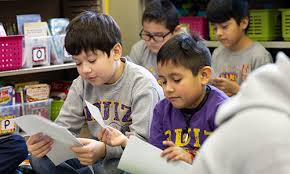
 I remember working with a small group of second graders at the reading table, listening as one student carefully worked through a word that had stopped her mid-sentence. She knew her sounds, but she wasn’t yet sure how they fit together, and she looked to me for reassurance before trying again.
Moments like that shaped how I came to understand effective reading instruction not as a collection of activities, but as intentional teaching grounded in how children actually learn to read. Today, those classroom experiences connect directly to what we call science of reading strategies: instructional practices rooted in decades of research about reading development and learning.
What is the science of reading?
The science of reading refers to a large, interdisciplinary body of research that explains how students learn to read and which instructional practices are most effective. This research comes from fields such as cognitive science, neuroscience, psychology, and education, and together it points to a clear message: unlike speaking, reading does not develop naturally. Most students need clear, intentional, and systematic instruction to learn how letters and sounds work together, build word recognition, and develop the language and knowledge needed to understand what they read.
At its core, the research helps educators understand how foundational skills like phonemic awareness and phonics support accurate decoding, how fluency develops through practice, and how vocabulary and background knowledge fuel comprehension. Importantly, this research points educators to instructional approaches that have been shown to improve reading outcomes for a wide range of students, including students who may require additional support.
Why evidence-based reading strategies matter
Using evidence-based reading strategies matters because instruction grounded in valid and reliable research leads to stronger, more reliable outcomes for students. When teachers rely on approaches aligned with how the brain learns to read, students are more likely to develop accurate decoding skills, read fluently, and comprehend increasingly complex texts.
In contrast, instructional practices that are not supported by a host of research can leave gaps in students’ reading development—gaps that become harder to close over time. Evidence-based instruction gives teachers greater confidence in their choices and makes student progress more likely while making students less dependent on guesswork.
Research-based teaching strategies for reading: Key characteristics
Research-based teaching strategies for reading share several defining characteristics aligned with the science of reading. These strategies are:
- Explicit, meaning teachers clearly model and explain skills rather than assuming students will make connections on their own
- Systematic, meaning instruction follows a purposeful sequence that builds from simpler skills to more complex ones
- Cumulative, meaning teachers regularly revisit and reinforce previously taught skills
- Data-aligned, meaning teachers use information from interim assessments, like MAP® Growth™ and MAP® Reading Fluency™, as well as formative assessment, to guide instruction
Together, these qualities reflect what research tells us about how students acquire reading skills and how teachers can intentionally support the process.
Science of reading instructional strategies
Below are eight actionable science of reading instructional strategies you can use when working on any of the components of reading with your students:
- Explicit phoneme-grapheme instruction (decoding). Teach sound-symbol relationships directly and systematically, modeling how to blend sounds to read words. For more on this, read “What the science of reading tells us about how to teach decoding—including phonics.”
- Word building and spelling routines (decoding/encoding). Use letter tiles or whiteboards to have students build, read, and spell words, reinforcing sound-symbol connections. The decoding article mentioned above can help with this, too.
- Repeated reading of connected text (fluency). Provide structured opportunities for students to reread short passages to build accuracy, rate, and prosody.
- Teacher modeling through think-alouds (comprehension). Make comprehension processes visible by modeling how to monitor understanding, make inferences, and summarize. For tips on supporting both fluency and comprehension, read “Supporting fluency and comprehension using practices grounded in the science of reading.”
- Explicit vocabulary instruction. Pre-teach and revisit high-utility and content-specific words, focusing on word meanings, relationships, and usage. I encourage you to read “How building students’ vocabulary through morphology improves reading comprehension” to learn more.
- Text-based discussion and questioning (comprehension). Engage students in purposeful talk using questions that require text evidence and reasoning. Here, too, our article on supporting comprehension can come in handy.
- Syntax and grammar instruction. Teach students to read, write, and manipulate sentences to strengthen comprehension. The discussion of syntax in our article “How the science of reading can help you teach language comprehension skills” can help with this.
- Data-informed small-group instruction. Use assessment data to group students and target instruction based on specific reading needs. Read “Decisions, data, and doing the science of reading” to learn more.
Research and practice in action
Science of reading strategies help bridge the gap between research and classroom practice, offering you a way to plan and deliver effective instruction. When teachers understand how students learn to read and apply evidence-based strategies intentionally, instruction becomes more coherent, responsive, and impactful. Just as those moments at the small-group table reminded me years ago, strong reading instruction is not accidental; it is built on knowledge, purpose, and a commitment to teaching what works.