 In “5 ways to help students develop a growth mindset in math class,” I wrote about several ways instruction in mathematics could borrow from instructional practices in ELA to bring about better student mindsets, opportunities, and conversations in class. Today, I’d like to focus on another discipline that is prioritizing a teaching strategy that mathematics should absolutely be leveraging: the discovery learning model.
Consider for a moment the kinds of activities that make a science lesson successful. Some of the things that come to mind are collaboration, inquiry-based activities, the scientific method, and hands-on experiences. And what do all of these have in common? An opportunity for teachers and students to experience critical exploration together in the classroom.
In many ways, mathematics instruction has much to learn from the discovery learning model approach. Most of the time, we don’t think of treating math in this way—as a discipline with ideas that should be explored, discovered, and made sense of authentically. All too often, the math subject matter becomes a cycle of stating the mathematical principle up front, modeling how to solve a problem using that principle, and then having students repeat it. In what ways could having students discover the mathematical principles themselves bring about more impactful learning experiences for our students?
What is the discovery learning model?
As noted in “A theoretical foundation for discovery learning,” the main objective of discovery learning is encouraging students to make sense of new information by relying on knowledge they already hold about the world. Marilla Svinicki, the article’s author, explains that “Rather than being passive recipients of large amounts of relatively unconnected information, students are being asked to make their own connections between what they are learning and what they have experienced in real life.”
The discovery learning model is rooted in the cognitive model of learning, she goes on to explain, “which focuses on what goes on in the mind of the learner as new information is acquired.” It prioritizes the following:
- Active learning. Active learning encourages students to focus on a task and key ideas so they can respond to questions related to a new topic and get immediate feedback on their comprehension from their teacher. Active learning can help with retention and motivate students, because they know they’re expected to participate.
- Meaningful learning. In the context of the discovery learning model, meaningful learning refers to the power of relying on students’ knowledge and experiences to make meaning of new information. It also points to the power in having students explore a process independently, rather than simply following directions; work with their preconceived notions on a topic; benefit from a concrete approach, rather than an abstract one; explore new information in real-world contexts; understand how the knowledge can be used outside the classroom; and solve problems more independently.
- Changes in beliefs and attitudes. As Svinicki notes, this characteristic of the discovery learning model refers to “a change in the way students think about advanced knowledge and their ability to conquer it.” Specifically, it’s about supporting learners in understanding that knowledge can be uncovered by them, rather than only coming directly from an authority; processes are more valuable than just facts; and they can take responsibility for and an active part in their learning.
A sample activity
In my classroom, students were no strangers to visual models. In each lesson, students were either creating, analyzing, or leveraging information from a model. Some of the most powerful conversations ever to be had in our room were based on finding patterns and making conjectures about what was going on in a particular visualization, especially one they’d never seen before.
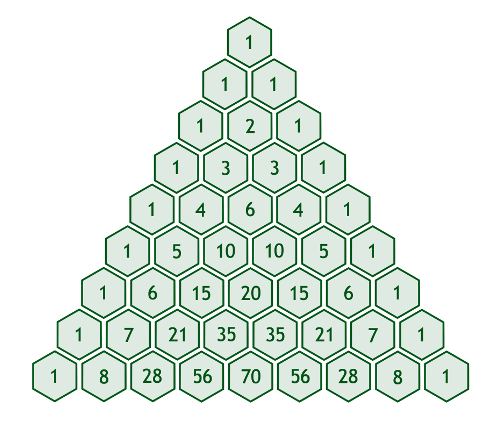
I started by displaying a model (for instance, Pascal’s triangle shown below) and telling students to take a moment to observe the model independently, looking specifically for number patterns and trying to figure out how the model worked.
Then, within our classroom community, members would take turns stating a theory about how a particular aspect of the model functioned. Students would be encouraged to go up to the board and justify their theory so it could be understood or acknowledged by all members of the community. Other members were encouraged to ask questions, offer a counter example, or agree with the conjecture. Once an idea had been proven or disproven by the group, the sharer would return to their seat, and another student and their idea would take the floor.
The goal of the activity was for all students to engage. Engagement could take many forms; students could be engaged by asking clarifying questions, agreeing with an idea, providing an example, proposing a theory, supporting another’s theory, or thinking critically about an idea. In every single instance, my classroom saw high levels of engagement and deep connections made among the many concepts of the discipline. Students were hungry to discover something for themselves or build on a novel idea from a classmate.
The beauty of such a practice is that there are no limits to how far you can dig into a robust model that holds numerous secrets. Although the community may start with simple ideas like “The first and last number in each row is always 1” or “Each number is the sum of the two numbers adjacent to it in the previous row” when looking at Pascal’s triangle, I’ve had students as young as second grade who dug deep to notice things like “The sum of each row is double the previous row” or even “Shading only the odd numbers reveals an interesting triangular pattern.”
To push students even further, I’d often extend the activity by issuing a challenge, like “Can you find the Fibonacci sequence hiding anywhere in this model?”
Behind the scenes of discovery learning
Now that I’ve showcased a sample activity, let’s look at what was happening behind the scenes.
While the age-old “I do, we do, you do” strategy has its place in teaching, authentic discovery remains a vital tool. By allowing students to make conjectures and discover patterns within a model, they can express higher levels of engagement and a more solid ownership over their learning.
The authenticity of a task also plays a vital role in student learning dispositions and motivation. A shared problem is brought to the attention of the learning community, and together we wrestle with the mathematical secrets that are there for the taking. Once we home in on something, we can all practice the art of listening to a theory and weighing the validity of the presented idea. There’s a reason critiquing the reasoning of others is a key facet of mathematical practice in most academic standard frameworks; this mathematical practice provides a meaningful path for deeper content knowledge and application beyond the discipline.
Additionally, the discovery learning model sheds light on an aspect of mathematics all too often ignored, oversimplified, or simply relegated to only grades K–2 by sets of content standards: pattern knowledge. Research suggests that pattern knowledge is predictive of proficiency in algebra, and there is also a wide array of research to support the idea that success in algebra (especially eighth-grade algebra) is correlated with higher college attendance and sustained interest in mathematics-related fields.
Another great benefit of the discovery learning model is the ability to meet students where they are. A student who tests below grade level may focus on the additive relationships or counting patterns in Pascal’s triangle while other students may be able to make connections to a wider range of concepts, for example. Planning student experiences with Open Middle math problems is a great way to get more bang for your buck in a single lesson; it keeps your learners with special needs—including both the students below and above grade level—engaged in the thinking.
And thanks to the interconnectedness of mathematics, you can go further with some students who are ready to chew on something a bit more complex. A subset of the community may be able to recontextualize “Each row is double the previous row” as “Each row’s sum shows a consecutive power of 2” or even “Shading the odd numbers reveals a pattern” as “Shading the odd number reveals a fractal known as Sierpinski’s triangle,” which in and of itself contains a lot of new patterns to discover. (For more on meeting the needs of students ready for a greater challenge in particular, I encourage you to read “3 ways to provide differentiated instruction for advanced learners.”)
Why the discovery learning model is so valuable in math instruction
Research supports that, with appropriate teacher guidance, inquiry-based learning can be more effective than many other instructional methods. An approach like this represents two major shifts from the traditional mathematics instruction model.
First, the what of the learning task is not immediately obvious. Students are not given an opportunity to quickly see what a lesson intends and then disengage from the conversation. A task centered in discovery—especially shared discovery—can pull at the curiosity of students, making them sit forward and take note of the wealth of possibilities able to be discovered.
Second, the how of the inner workings in the mathematics is not explicitly stated either. Students have every opportunity to find their own way through the terrain, which is ripe with ideas, methodologies, and connections. They have the time and space to observe the theories of others and try out their own hunches in a safe space that welcomes unique viewpoints and savors disagreement in strategy.
The two components of creating a community of observation
The process of creating a classroom community that is not only comfortable with but also maximizes learning possibilities with a discovery learning model is no small feat.
It’s no surprise that inquiry-based learning is best supported by solid classroom management. Once routines for your community are firmly in place, your classroom will be ready to intentionally dive into the unknown to explore and more concretely build foundations in the mathematical ideas your core curriculum is already hoping to foster.
Another valuable teaching strategy that paves the way toward implementing learning like this is the think aloud. In fact, the success of this method hinges on students understanding how to share their thinking, which requires many of them hearing how you, the teacher, think as well. Metacognitive teaching strategies substantially impact student performance in writing, science, math, and reading and have long-term positive effects on student academic performance, too. Starting early and often with talking out your stream of consciousness when attacking a novel math problem can help your students feel more confident in the hazy space between the complete unknown and knowing exactly what to do. And that’s where authentic learning happens.
With these precursors in place, it just becomes a question of what to provide your learning community to explore together. Ideally, the models or visuals you use should be saturated with ideas that connect to the learning your class has already undertaken or topics they are about to define more clearly. But just because students haven’t learned a formal definition or procedure for something does not mean they don’t already have the cognitive predisposition to explore that idea and find their own way through it.
Selecting the right model for your classroom
Selecting great mathematical models to build student engagement, natural curiosity, and confidence in the discipline is an opportunistic endeavor. While mathematics already has its own set of effective models (like the hundreds chart, multiplication table, or Prime Climb hundred’s chart) and interesting pattern displays from history’s mathematicians (like Pascal’s Triangle, Fibonacci’s Spiral, and Sierpinski’s Triangle), there are many other possible—and even simpler—applications of this approach to whole group discourse and inquiry.
Data literacy continues to be an aspect of mathematics instruction that deserves more airtime, for example. Compiling data tables, graphs, or even infographics into a session of discovery for students could yield some profound conclusions about the specific data, how the data visualizations work, or what the data tells us about the real-world context it represents.
Geometry also naturally lends itself toward visualization. Using angle relationships and definitions of polygons from a fourth-grade lesson, students could have the potential to analyze and make sense of many aspects of high-school level diagrams given the proper time and space to co-construct meaning, allowing you to get the most out of the discovery learning model.
Finally, consider where a strong visualization inundated with information and points of entry could replace the beginning of a math lesson you are planning, an intro to an upcoming unit, or a day of instruction entirely. With proper planning and adequate support during the task, students will rise to the occasion and just might surprise you with how much they can figure out on their own.