 If you’re leading a school or district today, you’re navigating unfinished learning, inconsistent attendance, rising social competence needs, and the daily expectation to deliver results for every student. In that reality, success depends less on adopting another program and more on building a system—one that organizes supports so they’re proactive, equitable, and coherent for staff, students, and families. That’s the promise of a multi-tiered system of supports, or MTSS: a straightforward, powerful way of working that helps every learner reach grade level—and go beyond it.
Why MTSS is urgent
Three realities make MTSS essential right now:
- Unfinished learning. Many students are still catching up on foundational skills, especially in early literacy and math, following COVID-19 school closures. They need targeted help to close precise gaps—without lowering expectations for grade-level work. At the same time, students who are ready for more need structured opportunities to go deeper, not just extra worksheets or “finish early” busywork. A tiered system lets you do both well: catch up and go beyond.
- Chronic absenteeism. Attendance patterns shape learning opportunities. Missing around 10% of the year is a practical threshold where achievement and graduation prospects start to dip. A system approach organizes what schools, families, and communities can do at each tier—universal belonging and climate, targeted mentoring and barrier-solving, and intensive wraparound supports—so action happens early and predictably, not after patterns become entrenched.
- Social competence and behavioral needs. Academic success and well-being are inseparable. MTSS integrates social competence and behavioral supports into the same structure, so students experience consistent, strengths-based support rather than a patchwork of responses.
Now that we’ve explored why MTSS matters, let’s look at how it shifts schools from programs to systems.
Moving from programs to systems
MTSS is much more than intervention. When most people hear the term, their mind jumps straight to special education, remediation, or students who need Tier 2 supplemental or Tier 3 intensive intervention. But MTSS is not a program for some kids—it’s a strategic framework for all learners, including students who are on grade level and those ready for Tier 2 extension and Tier 3 enrichment. It isn’t a system reserved for IEPs or remediation, nor is it a siloed initiative disconnected from core instruction. At its core, MTSS is a proactive, data‑driven approach that ensures every student has a pathway to grade-level proficiency and beyond. It strengthens Tier 1, organizes both Tier 2 and Tier 3 supports—including supplemental support, intensive intervention, extension, and enrichment—integrates academics, social competence, and behavior needs, and also aligns resources and teams so leadership can drive sustainable impact.
Think of MTSS as the highway, not the detour. Tier 1 is the main road—strong, standards-aligned instruction for all. Tier 2 supplemental and Tier 3 intensive supports are the on‑ramps that help students overcome barriers and accelerate to grade level. Tier 2 extension and Tier 3 enrichment are the express lanes that empower learners to go deeper into the richness of the standards rather than simply moving faster. When implemented with fidelity, MTSS doesn’t just close gaps—it opens doors for every learner.
And that’s why MTSS isn’t a program to buy or a checklist to complete. It’s a way of working that turns scattered initiatives into a coherent structure. Instead of reacting to problems one by one, MTSS creates predictable routines: teams meet regularly, review a small set of meaningful evidence, and make decisions about instruction and support—including extension and enrichment opportunities—that keep students moving forward without sacrificing core learning time.
Think of it this way: programs give you tools but systems give you habits. MTSS clarifies who meets, when they meet, what they look at, and how they decide. Those shared habits reduce decision fatigue, keep Tier 1 strong, and make Tier 2 and Tier 3 supports—across intervention, extension, and enrichment—purposeful instead of reactive. When these habits are in place, teachers spend less time guessing and more time teaching while students spend less time being pulled in different directions and more time learning.
With the big picture clear, let’s explore the MTSS diamond and what it looks like in practice.
The MTSS diamond: One system, distinct pathways—anchored in instructional coherence
Most of us have seen the triangle image of MTSS that has been a staple of professional development workshops for years. Increasingly, schools, districts and departments of education are moving toward the MTSS diamond framework because it tells a fuller story: MTSS is not just about intervention. It’s about multiple pathways inside one system—catching students up when they fall behind and creating opportunities for those ready to go deeper. Every pathway leads to the same destination: grade-level mastery and beyond.
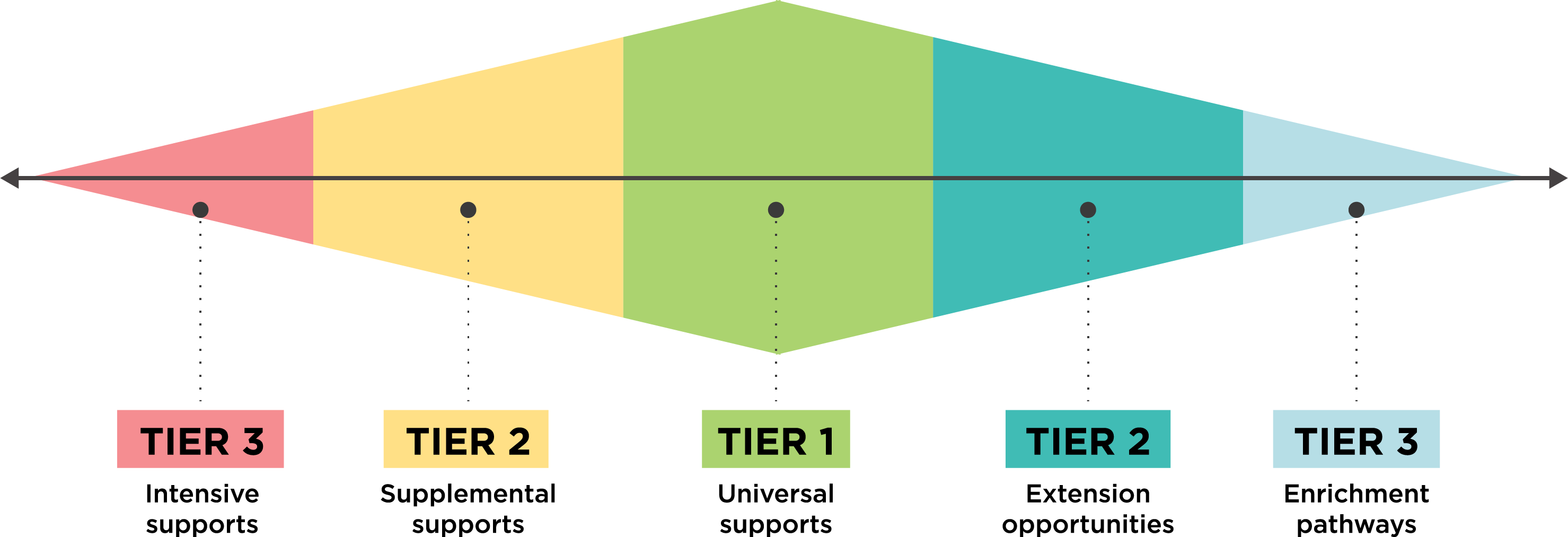 But here’s the critical point: the diamond works best when instructional coherence is in place. Coherence means that Tier 1, Tier 2, and Tier 3 aren’t separate worlds—they’re aligned to the same instructional vision, the same standards, and the same expectations for quality. Without coherence, MTSS becomes a patchwork of disconnected efforts: interventions that don’t connect to core instruction, enrichment tasks that feel random, and teams that spend more time troubleshooting than teaching.
Instructional coherence ensures that:
- Tier 1 instruction is strong and consistent across classrooms.
- Tier 2 supplemental supports target skills that matter for success in Tier 1 tasks.
- Tier 2 extension deepens the same concepts taught in Tier 1, not unrelated “extra” work.
- Tier 3 intensive supports and enrichment pathways connect back to grade-level goals and the district’s instructional priorities.
When coherence is present, MTSS feels like one system—not several separate programs. That’s what the diamond represents: distinct pathways, unified by a shared vision for teaching and learning:
- Tier 1: Universal supports (the anchor). This pathway is comprised of standards-aligned, high-quality materials, Universal Design for Learning (UDL) for multiple access points, scaffolded supports that raise expectations, rich classroom discourse, and formative assessment guiding real-time instruction.
- Tier 2: Supplemental supports (targeted intervention). This pathway addresses specific skill gaps that block success with grade-level work. Students are identified through screening and diagnostics, grouped flexibly, and taught with targeted practices. Supports are time-bound, skill-specific, and monitored for impact—designed to help students catch up without losing Tier 1 access.
- Tier 2: Extension opportunities (structured depth). Tier 2 extension opportunities offer structured depth for students ready to go further. Extension isn’t “more of the same” or faster pacing—it’s complexity: analyzing datasets, constructing layered arguments, building models, solving multi-step problems. Aligned to Tier 1 concepts, extension feels integrated—not like an add-on.
- Tier 3: Intensive supports (individualized intervention). The first of two Tier 3 pathways provides individualized help for the few students needing greater precision. Using data-based individualization—diagnostics, frequent checks, iterative adjustments—teams can reduce barriers while maintaining Tier 1 participation.
- Tier 3: Enrichment pathways (authentic advanced work). This pathway includes authentic enrichment: mentored research, design challenges, real-world problem solving, internships, and public demonstrations. Assessment is product-focused; think portfolios, prototypes, and exhibitions judged for quality and impact.
Once the pathways are clear, the next question is, how do we make this system live in the school day?
Making the system work day-to-day
A system is only as strong as its routines. MTSS succeeds when it moves from theory to daily and weekly practice—embedded in what teachers and teams do every day and every week, not just during special meetings or initiatives. Four pillars make this possible, turning MTSS from aspirational to actionable:
- Screening and progress monitoring. Early identification prevents small gaps from becoming big ones. Frequent monitoring ensures interventions are working and students aren’t stuck in the wrong tier.
- Protected time (WIN blocks). Without dedicated time, intervention and enrichment compete with core instruction—and Tier 1 always loses.
- Collaborative teams with clear protocols. MTSS is a team sport. Structured agendas for data review, decision rules for tier movement, and norms for documenting next steps keep meetings purposeful.
- Light-touch fidelity checks. Systems drift without feedback. Quick observations or check-ins focused on support—not punishment—keep improvement continuous.
These routines prevent the diamond from collapsing under its own weight. They make the system predictable for staff, humane for students, and sustainable for the long term. When these habits are embedded, MTSS stops being a binder on a shelf and starts being the heartbeat of the school day.
And because belonging drives achievement, attendance deserves its own spotlight.
Attendance as a leading indicator: Belonging drives achievement
Attendance is more than a number—it’s a signal. When schools treat it as a compliance report, intervention comes too late, after patterns have hardened and opportunities have been lost. But when attendance is viewed as a leading indicator, it becomes a powerful early warning system that prompts timely, tiered action. This shift changes everything: instead of reacting to chronic absenteeism months after it begins, schools respond to the first signs of disengagement with strategies that build connection and remove barriers.
At the universal level, the focus is on belonging. Students are greeted warmly when they arrive, advisory structures create small communities of care, and first-period classes are designed to spark interest rather than dread. Communication with families is clear and empathetic, emphasizing partnership instead of punishment. These practices make showing up feel safe and meaningful.
When patterns of absence begin to emerge, targeted strategies come into play. Students might be paired with mentors who check in regularly, or engaged in short, structured conversations that uncover obstacles before they escalate. Schools work to solve practical barriers—transportation issues, scheduling conflicts, or academic stress—so students can reengage quickly.
For students facing chronic absenteeism or complex challenges, intensive supports are essential. These often involve wraparound services that coordinate health care, housing assistance, transportation barriers, and counseling. Schedules may be adjusted to accommodate unique circumstances, and credit recovery shifts from seat-time requirements to mastery-based progress, allowing students to regain ground without unnecessary delays.
This approach reframes attendance as a measure of belonging and readiness to learn, not just compliance. When schools act early and offer tiered support, they send a clear message: every student matters, and every barrier can be addressed. Belonging drives achievement—and MTSS provides the structure to make that promise real.
When students feel connected and supported enough to show up, the question becomes how to make every minute of learning count—and that’s where clear, purposeful data-powered practices come in.
Data-powered teaching (without overload)
Data should serve instruction—not overwhelm it. In a strong MTSS system, evidence is treated as a set of signals that guide teaching decisions, not as artifacts collected for compliance. When educators see data as actionable insight rather than paperwork, it becomes a tool for precision and responsiveness.
Screening provides the first signal: who might need more support or challenge? Diagnostics sharpen the picture by clarifying what specific skills or concepts require attention. Progress monitoring then answers the critical question, is the support working? These layers of evidence prevent guesswork and allow educators to adjust quickly rather than waiting for summative results.
But the most powerful data often comes from the classroom itself. Student work and formative checks—exit tickets, quick writes, problem-solving tasks—inform daily decisions: reteach a concept, regroup students for targeted practice, enrich for those ready to go deeper, or extend learning through application. This is where MTSS becomes dynamic, not static.
For interventions, progress checks should align directly to the skill being taught, not a broad measure that obscures growth. For enrichment and extension, performance evidence matters most—rubrics that capture reasoning, milestones that show progress toward complex tasks, and exhibitions that demonstrate creativity and transfer. These forms of evidence honor advanced learning as more than speed; they measure depth.
The goal is clarity without overload. Data should illuminate the next best step for teaching, not drown educators in reports. When evidence is streamlined and purpose-driven, MTSS empowers teachers to act with confidence and precision—making every instructional minute count.
And while clear, purposeful data practices strengthen daily instruction, they’re only truly effective when leadership builds the conditions that make MTSS sustainable and coherent across a school or district.
Leadership: Conditions that make MTSS sustainable
No framework sustains itself. MTSS flourishes only when leadership transforms vision into actionable systems—embedding it into schedules, resources, professional learning, and accountability structures so it becomes part of daily practice rather than an initiative that fades. Four leadership imperatives make this possible:
- Protect time. MTSS doesn’t work without time built in for intervention, extension, collaboration, and data review. Leaders need to lock these blocks into the master schedule and defend them from competing priorities.
- Publish clear guardrails. Nothing derails MTSS faster than ambiguity. Spell out the non-negotiables—like when screenings happen, how often progress is monitored, and what triggers movement between tiers. Clear guardrails keep everyone on the same page and prevent confusion about what “counts” as MTSS.
- Invest in coaching for confidence and coherence. Teachers implement MTSS when they feel supported, not scrutinized. Coaching should focus on building instructional skills and connecting MTSS to core curriculum, not just compliance. Coherence matters: align MTSS practices with district priorities so it feels integrated, not layered on.
- Have a leadership mindset. MTSS is not a rigid staircase—it’s a fluid system designed to respond to student needs in real time. Students should never be locked into a tier or labeled by a level; instead, they should receive the right support or extension at the right moment. The same student may need intervention in one unit and enrichment in another, depending on the skill, subject, or context. That is not inconsistency—it’s responsiveness. For this to happen, leadership must communicate a clear message: MTSS is not a track, and it is not a label. It is a dynamic framework that ensures every learner has access to grade-level content and opportunities for growth. Leadership sets the tone: students are not the numbers, or the tiers.
When leaders create the systems that make MTSS sustainable, those structures translate into visible, measurable outcomes across classrooms, teams, and student experiences.
What success looks like
When MTSS works, it’s visible in every layer of the school experience. Success is not just about compliance—it’s about creating a culture where every learner thrives, and every educator feels empowered.
- Tier 1 instruction is strong and consistent.
- Students move in and out of Tier 2 supports quickly.
- Advanced learners engage in meaningful extension.
- Attendance improves because belonging is built in.
- Teams feel confident because decisions are clear.
- Equity and excellence move together.
Read “How Arlington ISD built a strong, data-driven intervention system” on Shaped, the corporate blog of our parent company, HMH, to learn more about what MTSS success can look like.
Seeing what MTSS can accomplish is powerful—but translating that vision into day‑to‑day practice starts with a clear, intentional first step.
Getting started and the work ahead
The journey to MTSS success doesn’t begin with complexity—it begins with clarity. Start small. Define your MTSS vision on a single page so every stakeholder knows what you stand for and where you’re headed. Protect time for planning and for WIN blocks, because without time, even the best intentions collapse under competing priorities. Adopt a simple data protocol that turns numbers into action, not noise. Audit your interventions and advanced learning opportunities to ensure they are purposeful and equitable. Then pilot in one grade band, learn from the experience, and scale with confidence.
This is not about adding another initiative. MTSS is the connective tissue that brings coherence to everything schools care about: serving all students, attendance, instruction, supplemental supports, intensive supports, extension, enrichment, social competence education, and leadership. It transforms scattered efforts into one integrated system—a system that offers the discipline schools need to be proactive and the flexibility teachers need to respond to real students in real time.
The work ahead is ambitious, but it is also deeply hopeful. MTSS delivers on the promise of public education: every learner, every classroom, every day. It ensures that no student’s potential is left to chance and no teacher is left without support. When schools commit to this vision, they create a culture where belonging drives achievement, where gaps close and opportunities expand, and where equity and excellence move forward together.
At its core, MTSS turns complexity into clarity. It’s how schools organize to notice needs early, respond quickly, and keep grade-level learning at the center—while expanding opportunities for those ready to go further. Done well, it makes belonging visible, turns data into action, and reduces variability across classrooms so serving all students becomes a lived experience, not just a promise on paper.