 A massive and destructive winter storm barreled through the country in January, impacting communities in over 40 states and forcing thousands of schools to restrict in-person instruction for safety reasons. Unlike the past—when a snow day meant no school and a makeup day later—many districts now rely on remote learning to keep instruction going. This shift has sparked strong opinions: some appreciate the continuity in instruction, while others miss the joy and mental break of a traditional snow day.
Why districts are considering remote learning days
Given the collective nostalgia for snow days past, requiring remote learning days may seem like an unpopular choice for a leader to make. Acknowledging this potential unpopularity, New York City Mayor Zohran Mamdani told students they could “pelt him in the face” with snowballs for instituting a remote learning day during the recent winter storm.
So why are districts using remote learning days? A primary reason is state-mandated instructional time requirements. Districts must meet minimum hours or days, and extended weather-related closures can quickly put them at risk of falling short. Remote learning helps avoid adding makeup days at the end of the year or cutting into scheduled breaks.
Another motivator for remote learning days is the belief that missing school for an extended period will negatively affect student learning. However, there is little recent research on the impacts of snow days. The two studies that focus directly on the impacts of snow days came to different conclusions. A study of Massachusetts students from 2003 to 2010 found that missed instruction due to snow days did not negatively impact learning, but snow-related absences did, while a different study of Maryland students from 1994 to 2005 found that students had lower test scores in school years with more snow days. Both studies were conducted prior to the possibility of remote learning days and cannot speak to how these days may mitigate any effects of missed instruction.
Research on school disruptions due to natural disasters, like hurricanes and wildfires, has found that missing school for a week or more can decrease student learning. However, these studies can’t disentangle missed instructional time with other disruptions to families and communities, and so likely are an overestimate of the potential effects of a typical snowstorm. In summary, we don’t have a great understanding of exactly how much school kids would need to miss for there to be a negative impact on learning or how successful remote learning days are at mitigating such an effect.
Where remote learning days are allowed
COVID‑19 dramatically expanded districts’ capacity to offer remote instruction. Despite this widespread increase in capacity, states have taken very different routes in their policies around remote learning days (as seen in Figure 1 below). As of the 2025–26 school year, we found that:
- Four states (including Arkansas and Massachusetts) plus the District of Columbia prohibit counting remote learning toward instructional time, meaning make-up days are required if weather closures drop a district below the minimum.
- Twenty-three states limit how many remote days can count, requiring schools to make up any additional inclement weather days. Limits are typically three to five days, but they climb up to 10 in several states, including Virginia and Kentucky.
- Twenty-three states allow district discretion on remote learning for inclement weather or do not appear to have a specific policy declaring a maximum of remote learning days.
Figure 1. State remote learning during inclement weather policies
Among states that allow remote learning, states also vary in the degree to which they encourage or discourage districts to select the option. For example, Virginia encourages the use of remote instruction on these days because it “ensures educational continuity during disruptions.” However, other states are hesitant about the use of remote learning days but allow them with restrictions. The Kansas State Department of Education, for instance, allows up to 40 hours of remote learning per student but cautions that “using remote learning building-wide in lieu of canceling school should be considered only in extreme circumstances.”
Additionally, states vary in the requirements for what a remote learning day must look like. While some do not have any official criteria, others, like New York, have requirements for device and internet access, durations of synchronous and/or asynchronous instruction, and ensuring access and services for students with special needs.
Finally, there are also other states where districts are permitted a limited number of weather-related closure days to occur without needing to schedule make-up days (e.g., Georgia, Idaho, Michigan). In these states, remote learning days are typically still available but less likely to be used except in the case of extremely long closures.
Tradeoffs: Remote learning vs. traditional snow days
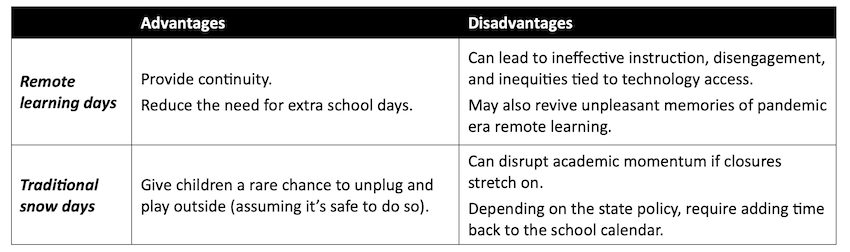
Remote learning days generally have some key advantages as well as some real disadvantages over traditional snow days:
 Key questions for district leaders
The effectiveness of a remote learning day is also highly dependent on local and state contexts. Below, we outline the primary questions to ask to ensure that the use of a remote learning day can be as effective as possible.
- What does the state require? State policy determines whether districts must make up instructional time lost to inclement weather and whether remote learning days may count toward required instructional days or hours.
- What are the conditions on the ground? Are power outages likely? If families lack power and/or internet, remote days aren’t feasible.
- How long is the closure anticipated to be? Short closures (1–3 days) are less likely to have lasting impacts on students’ achievement than longer closures. The longer the break, the more likely that remote learning days will provide some sort of academic stability.
- Is your district technologically prepared for a remote learning day? Are platforms stable? Are teachers trained? Districts have better capacity today, but glitches still happen.
- Are families in your district willing and able to support remote learning? Remote learning often depends on adult support at home, especially for younger students, where working caregivers may face real challenges.
What should districts do?
There’s no one-size-fits-all approach. Decisions should factor in state requirements and local context. Once a path is chosen:
- If using remote learning days: Ensure teachers have tools, training, and clear expectations to make the day meaningful. Given that attendance is likely to be lower, teachers may be better off focusing on review rather than introducing new material.
- If scheduling a snow day and then relying on make-up days: Make up for missed instruction by using built-in snow days, extending the school year, lengthening school days, or adding days into breaks. Note that evidence suggests extending the school year is more effective than lengthening each day. Makeup days during major holidays and breaks (such as winter or spring break) often suffer from low attendance.