 Every time I work with a district that is rethinking how it supports students, the same question comes up sooner or later: Where does MTSS belong? Should it sit in Special Education? Should Student Services run it? Should Teaching and Learning take the lead? Should it live at the district office or in each school?
It makes sense that people ask. When a system is complicated, we look for a person or a department to carry it. But the more I see MTSS in action, and the more I support teams across different contexts, the clearer the answer becomes: MTSS does not work well when it belongs to only one department. It also does not work well when it is treated as a service that gets delivered after a student shows signs of struggle. MTSS only functions the way it was intended when it is built as a structure that everyone shares and everyone owns.
This idea sounds simple, but it has powerful implications for how a district organizes itself, how teachers collaborate, how leaders set priorities, and how students experience school.
Why MTSS does not live in Special Education
When MTSS lives inside Special Education, it usually happens for understandable reasons. Special Education teams are incredibly strong at designing individualized supports, progress monitoring, documentation, and intervention. They already run systems that require precision, expertise, and collaboration.
The problem is not the expertise. It is the message the placement sends.
As soon as MTSS lives only in Special Education, it is easy for people to assume that MTSS is about what happens once students fall behind. The work becomes focused on intervention rather than instruction. Conversations begin to revolve around who gets pulled out and what program should be used. Data meetings shift toward sorting students rather than improving instruction. Teachers start to believe that someone else is responsible for fixing learning gaps.
None of this is intentional, but it is predictable. When one department owns MTSS, especially a department that has historically been connected to remediation and eligibility, the entire system starts to see MTSS through that lens.
But MTSS was never meant to be a Special Education initiative. It is a general education framework. It is a design for instruction, access, prevention, and coherence. It lives in the daily experience of Tier 1 instruction, in the way grade-level learning is protected, in the routines and planning structures that guide teacher teams, and in the systems that help a school respond to learner variability.
This is why the most successful districts position MTSS at the systems level rather than inside a single office. Special Education remains a critical partner, but not the owner. When MTSS becomes a shared responsibility, every department and every school sees its role in improving access to instruction, not just delivering intervention.
Why MTSS cannot be treated as a service
A second misunderstanding often sits right next to the first one: Many people assume MTSS is something we give to students. Something we turn on once they are behind. Something that gets delivered in addition to core instruction.
But MTSS was never meant to operate that way. When MTSS becomes a service, the entire conversation shifts in an unhelpful direction. People begin to talk about who qualifies and who does not. They think of MTSS as time away from grade-level instruction rather than time that strengthens it. And once again, the work becomes reactive rather than proactive.
MTSS is not a service for the simple reason that services come and go based on student need, but structures stay in place to guide an entire system. A service focuses on what we do for individual students, while a structure shapes how the system works for all students.
Thinking of MTSS as a structure changes everything. It reminds us that the goal is to protect access to strong Tier 1 instruction. It reminds us to strengthen curriculum, instruction, and assessment before turning to intervention. It reminds us that the purpose of data is to improve the system, not to label students. And it reminds us that the work of MTSS belongs to the entire system, not to a handful of specialists.
Why Tier 1 must sit at the center
This brings us to the heart of MTSS: Tier 1 instruction. When people use the MTSS diamond instead of the traditional triangle, it sends a different message. The diamond places Tier 1 in the center of the system and layers support around it rather than on top of it. Students do not leave the core to receive support; they stay connected to grade-level instruction and receive what they need around it.
This matters because Tier 1 is the daily instruction students experience. It is the curriculum, tasks, questions, scaffolds, routines, opportunities for discussion, and ways teachers respond when students need help. If Tier 1 instruction is inconsistent, inequitable, or disconnected from grade-level expectations, then no amount of intervention will solve the problem. The system will always be in reactive mode.
A strong MTSS framework starts with strong Tier 1 design. That design is built through thoughtful planning routines, aligned materials, predictable structures for collaboration, and a shared understanding of what grade-level instruction looks like. This work belongs to Teaching and Learning, Curriculum and Instruction, school leaders, and teacher teams. When Tier 1 is the anchor, MTSS becomes a way to support instruction rather than a way to compensate for it.
What changes when MTSS is a shared structure
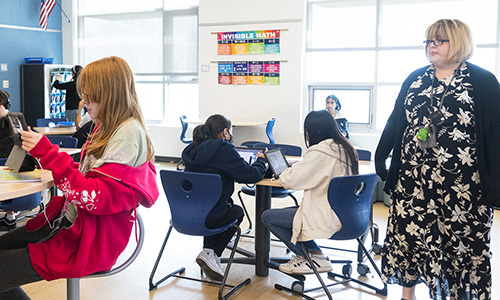
Once MTSS is placed at the systems level and shared across departments, the work begins to feel different. Conversations become more connected. The focus shifts from programs to instruction. Teachers feel more supported because they are planning with others instead of trying to solve problems alone. Specialists become collaborators instead of separate service providers. And leaders can make decisions with a clearer understanding of how changes in one area affect the whole system.
This shift also helps students with IEPs in important ways. They remain part of Tier 1 instruction while receiving the specialized services outlined in their plans. Their access to grade-level content is protected. Co-teaching models become easier to design because departments are aligned. And the system becomes more coherent for the adults who serve them.
In this design, intervention still matters. It is essential. But it is no longer the center of the system. Instead, intervention becomes a layer of support that enhances instruction rather than replacing it. Students who need more time, more practice, or more explicit instruction get it, but they do not lose access to the core while receiving it.
How districts begin the shift
Districts do not transform MTSS overnight. The work usually begins with the way leaders talk about it. When leaders begin to speak about MTSS as a structure and not a service, the system follows.
They recenter Tier 1 in their messaging. They protect common planning time because they know MTSS depends on it. They ask questions that focus on access to grade-level instruction rather than on placement. They revise data routines, so teams look for patterns in instruction rather than labels for students. They review schedules through the lens of access so students with IEPs or multilingual learners are not removed from core instruction. They bring departments together to make decisions as a unified team.
These changes are not flashy. They are not dramatic. They are steady, practical shifts that move a system toward coherence. They reduce noise. They build shared understanding. And over time, they lead to improved outcomes because the system stops trying to solve problems in isolation and starts aligning around common goals.
What you see when the structure takes hold
When MTSS functions as a shared structure, schools feel calmer and more coordinated. Teachers know what to expect. Students receive help earlier. Leaders have clearer routines for monitoring the health of the system. Specialists spend more time planning with teachers and less time putting out fires. Support becomes proactive rather than reactive.
Students benefit most from this shift. They stay connected to grade-level content and receive support while engaging in meaningful work. They move in and out of groups fluidly because the system is responsive, not rigid. They experience fewer interruptions to instruction. And they build more confidence because the system is designed to meet their needs rather than sort them.
The work becomes grounded in a simple idea: Everyone contributes to access. Everyone strengthens Tier 1. Everyone helps shape the routines that support learners. MTSS becomes an expression of collective responsibility, not a program or a compliance task. And when the system works this way, the entire school culture shifts toward prevention, access, and collaboration.
A question worth asking
As you reflect on your own MTSS system, you may find it helpful to step back and consider one simple question: What has our system been designed to protect, services or access to learning? The answer to that question will tell you more about the health of your MTSS framework than any flowchart or program inventory ever could.
If your system protects access, then MTSS will naturally align around Tier 1, coherent planning, shared ownership, and strong collaboration. If your system protects services, then MTSS will drift toward intervention, sorting, and reactive decision making.
The good news is that systems can change. MTSS does not require new programs or new people. It requires clarity, shared understanding, and a commitment to design the system around the thing that matters most: access to grade-level learning for every student.
A simple reflection to try
Here is a question you might take to your next leadership meeting or MTSS team: In one sentence, how do we want MTSS to function in our district, and what is one routine we will strengthen in the next month to make that vision real?
You do not need complex frameworks to start this work. You need clarity. You need alignment. And you need a structure that everyone owns.
Because MTSS is not a service. It is not a department. It is not something a single team can run.
MTSS is the structure that helps your system protect access to strong Tier 1 instruction and the support students need to succeed. And that structure belongs to everyone.