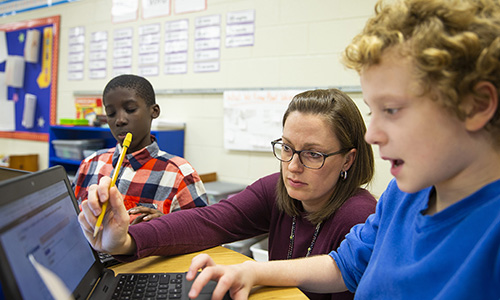


Using formative assessment strategies in class during instruction can provide the instant feedback teachers need to identify which learners need more help and adjust their instruction and lesson plans accordingly. Below are 27 quick and easy formative assessment strategies to get you started.
What is formative assessment?
“Formative assessment” is a term used in education to refer to in-the-moment check-ins teachers have with students to gauge how well they are understanding content. Formative assessment should never be graded and can be as simple as asking a single question of your class at the start of a lesson and having students hold up a whiteboard with their response for you to see.
To learn more, read the article “What is formative assessment?” here on Teach. Learn. Grow.
List of formative assessment ideas
There are numerous tried and true formative assessment strategies for you to choose from in your classroom. We’ve sorted our list of 27 of our favorites into the following six groups to make it easier for you to select the methods that are right for you and your students:
- Activating prior knowledge and pre-assessment
- Checking for understanding and feedback
- Visible thinking and organizing ideas
- Student explanation and sense-making
- Collaborative learning and idea development
- Reflection and metacognition
Activating prior knowledge and pre-assessment
Purpose: To identify what students already know, what they think they know, and what questions or misconceptions they bring to learning.
When to use: At the start of a lesson or unit to inform instruction and connect new learning to prior knowledge.
- Big Picture. Ask students to write down a few major things they know about a topic. For example, before a lesson introducing division, students may jot down that they know how to add, subtract, and multiply numbers. They may also note that the word “division” probably has something to do with dividing, or breaking a larger amount of something into smaller pieces.
- Entrance Ticket. Ask a question at the start of a lesson, and have students write their responses on index cards or strips of paper. Use those answers to assess your students’ initial understanding of something you plan to discuss in that day’s lesson. Be sure to provide a question that calls for more than a yes or no answer, can be answered quickly, and leaves space for you to adjust your lesson in the moment, if needed.
- Parking Lot. This strategy offers a home for student questions that may be tangential but provide insight into student thinking and understanding. Simply save a spot on your whiteboard to write down these questions, with the goal of revisiting them later.
- Three Questions. Ask your students three questions about a topic. Have them rank the questions in order of importance. Let them know that you will answer the questions during your lesson.
- Yes/No Chart. Share the most relevant ideas for a lesson with your class. Have each student write them down on a sheet of scrap paper that has two columns: one for ideas they already understand (the “yes”) and another for those they’re less sure about (the “no”).
Checking for understanding and feedback
Purpose: To gather quick, low-stakes evidence of student understanding while instruction is in progress.
When to use: During instruction or practice to decide whether to move on, adjust pacing, or reteach.
- ABCD Cards. Think of this as interactive multiple choice. First, make sure each student has four index cards or scraps of paper, each labeled with one of the first four letters of the alphabet. Then ask a question with four possible answers. Ask your students to hold up the card for the answer they think is correct.
- Basketball Discussion. Ask a question of your class and throw a soft ball at a student who volunteers to answer it. Once they’ve answered, they can gently throw or pass the ball to another student, who is charged with agreeing or disagreeing with the answer and explaining why.
- Corners. This, too, is an interactive type of multiple choice, but with this formative assessment example, each corner of your classroom corresponds to one of the following choices: agree, strongly agree, disagree, strongly disagree. Share a lesson-related statement with your class and have them move to the corner that represents how they feel about the statement.
- Keep the Question Going. Ask one student a question and then ask another student if that answer seems reasonable or correct. Then ask a third student for an explanation of why there is an agreement or not.
- The Popsicle Stick. Write the name of each student on a popsicle stick and put them in a jar. Ask a question of the class, then draw a name from the jar and ask that student to share their understanding on that topic.
- Think-Pair-Share. First, pose a question to your class. Then, ask students to write down their response before pairing with a partner to discuss what they wrote. Finally, have pairs of students share their answer with the larger group.
- The Whiteboard. Provide each student with a whiteboard or even a blank sheet of paper. Ask a question that can be answered with one or just a few words. Have students hold up their answers so you can check for understanding.
Visible thinking and organizing ideas
Purpose: To surface student thinking through visuals, comparisons, and structured representations.
When to use: When students are working with complex ideas or when you want to uncover misconceptions.
- Dos and Don’ts. Ask your students to write down three dos and three don’ts related to a topic they’re learning about.
- Draw It. Ask your students to make a quick sketch of what they understand about a topic.
- New Clothes. Select a topic related to your lesson and ask students to share how they might use that learning in a new way. Think back to the division example mentioned earlier, for example. If your lesson focused on the most basic nuts and bolts of division, you could ask your students how they might use division in their home lives, like maybe when cutting slices in a birthday cake or figuring out how all five members of a family can share a bowl of Halloween candy.
- Three Common Misunderstandings. Ask students to write down three things they think someone might misunderstand about a topic.
- Venn Diagram. Have students draw a Venn diagram so they can visually compare and contrast ideas.
Student explanation and sense-making
Purpose: To support students in clearly articulating what they understand and why.
When to use: After a key learning moment to deepen understanding and reinforce learning targets.
- Explain What Matters. Ask students to explain the single most critical idea about a topic in two or fewer sentences.
- 30-Second Share. Give each student 30 seconds to share something they learned in a lesson.
- Self-Directed Response. Ask students to write, draw, or speak something they know about a topic, but challenge them to imagine they’re engaging with a stranger who knows nothing about it.
Collaborative learning and idea development
Purpose: To deepen understanding through structured collaboration where students learn from one another.
When to use: When discussion, multiple perspectives, or shared problem-solving will strengthen learning.
- Carousel Brainstorming. Set up stations around your classroom, each with a question or prompt alongside some chart paper or something else your students can write on. Have groups of students make their way through each station, jotting down their ideas. When students return to their first station, start a discussion by having each group share out to the class.
- Jigsaw. Break a topic up into several pieces, and assign those pieces to groups of students. Direct each group to write down and synthesize everything they know about their piece of the larger topic before sharing their knowledge with the class.
Reflection and metacognition
Purpose: To help students think about what they learned, how they learned it, and what they need next.
When to use: At natural stopping points to inform next steps and build student ownership of learning.
- Assessment Reflection. Give your students a list of questions designed to help them reflect on an assessment. For example, you could ask them to state whether they were engaged during an assessment and why or to explain what they found most challenging and why. Have them turn in their answers for you to review later.
- Exit Ticket. Exit Tickets are similar to Entrance Tickets. Ask a question of your students—this time at the end of a lesson—and have them write down their response. Review their answers after class but before beginning work on your next lesson plan.
- One-Minute Paper. Near the end of the school day, ask your students, either individually or with a partner, to respond in writing to a single prompt designed to help you identify the most common spots for confusion or even understanding. You could, for example, ask them to write down what they thought was the most important learning of the day, or they could write down something that confused them or that they think might appear on a unit test or quiz.
- 3-2-1. At the end of a lesson, ask students to share three things they didn’t know before, two things that surprised them, and something they’d like to do with the knowledge they’ve gained.
- Two Stars and a Wish. At the end of a lesson, ask students to write down two things they feel good about related to their learning (those are the stars) and one they feel less confident about (that’s the wish).
Dig in with formative assessment methods
All 27 of these formative assessment methods are simple to administer. They’ll provide you with the evidence of student learning you need to make lesson plan adjustments and keep learning on target and moving forward. They’ll also give your students valuable information so they can adjust their learning tactics and know where to focus their energies.
If you’re not quite sure where to get started, the following discussion questions can help.
Questions for teachers
- How do you use formative assessment data to inform instructional decisions?
- How can formative assessment strategies foster a learning environment of collaboration and engagement?
- How do formative assessment strategies elicit evidence of student learning?
- What is one strategy you could try tomorrow and why?
Questions for leaders
- How do you use formative assessment data to drive school-wide instructional academic decisions?
- How can you model formative assessment strategies in staff meetings, PLCs, and meetings with teachers?
- What are three formative assessment strategies you could bring to your teachers and staff? Why do you feel these would be most effective at your school?
To learn more, visit the formative assessment archive for Teach. Learn. Grow., and get more formative assessment tips and tricks in our eBook “Making it work: How formative assessment can supercharge your practice.”