 Most schools are not lacking effort around MTSS. If anything, they are often overflowing with effort. Leaders create teams, protect intervention time, review data, buy tools, and build structures because they want students to succeed. Teachers work hard to respond to what learners need. Specialists, coaches, and support staff bring expertise and care.
And still, even with all that effort, MTSS can feel more fragmented than it should. In some places, it becomes shorthand for intervention meetings, assessment windows, forms, eligibility conversations, or schedules. Tier 1 can start to feel like regular instruction that sits beside MTSS instead of the center of it. Support may be organized, but it’s not always connected to what students are learning right now. Enrichment may exist, but only when an individual teacher has the time or idea to create it. Data may be everywhere, but it’s not always used in ways that change what learners experience next.
That is why it helps to come back to a simple idea: MTSS is not a program, a checklist, or an intervention structure for some learners. MTSS is a way of designing the system. It is how a school or district organizes instruction, response, and continuous improvement so every learner can access meaningful grade-level learning, receive the support and challenge that make sense right now, and keep moving forward with dignity.
That shift sounds simple, but it changes almost everything. When MTSS is treated mostly as an intervention framework, the system waits for evidence that something is not working and then responds. When MTSS is treated as system design, the system starts earlier. Teams ask what learners may need before the lesson begins, what kinds of challenge should be ready when students show readiness, and what routines will help educators adjust without turning temporary needs into permanent labels. That broader view begins with the part of the system every learner should experience first: meaningful Tier 1 learning.
Anchor the system in meaningful Tier 1 learning
One of the biggest shifts leaders can make is to stop thinking of MTSS as something that begins after students struggle. In a coherent system, MTSS begins with Tier 1. Tier 1 is not outside the system. It is the anchor. It includes the grade-level instruction, universal supports, relationships, routines, and learning conditions that every student needs to meaningfully engage.
That changes the questions teams ask. Instead of beginning only with, Which students need something more? teams also ask, What needs to be true in Tier 1 so students can access, belong in, contribute to, and grow through meaningful learning? When Tier 1 is clear, consistent, and protected, everything else becomes more precise. Support stays connected to current learning. Extension deepens the same learning instead of becoming extra work. Enrichment becomes part of the system’s promise, not something reserved for a few students or a few classrooms.
For example, when a group of students needs support with fractions, a Tier 1–centered system does not only ask where those students should go for extra help. It also asks what is happening in the core learning experience. Were the models clear enough? Did students have enough time to connect the representation to the concept? Did language demands get in the way of mathematical reasoning? Are other students ready to compare strategies or apply the concept in a more complex context? The response may include targeted support, but it should also include learning from what the pattern reveals about Tier 1.
This is where many schools have a real opportunity. They may already have strong interventionists, committed teachers, thoughtful leaders, and teams that meet regularly. The next step is not always to add one more thing. Sometimes the next step is to make the work already happening more connected. Once Tier 1 is clearly understood as the anchor, leaders can begin to ask whether the full system of support and challenge is visible, intentional, and connected.
Design support and challenge as one coherent system
The MTSS diamond is useful because it helps us see the full promise of responsiveness.
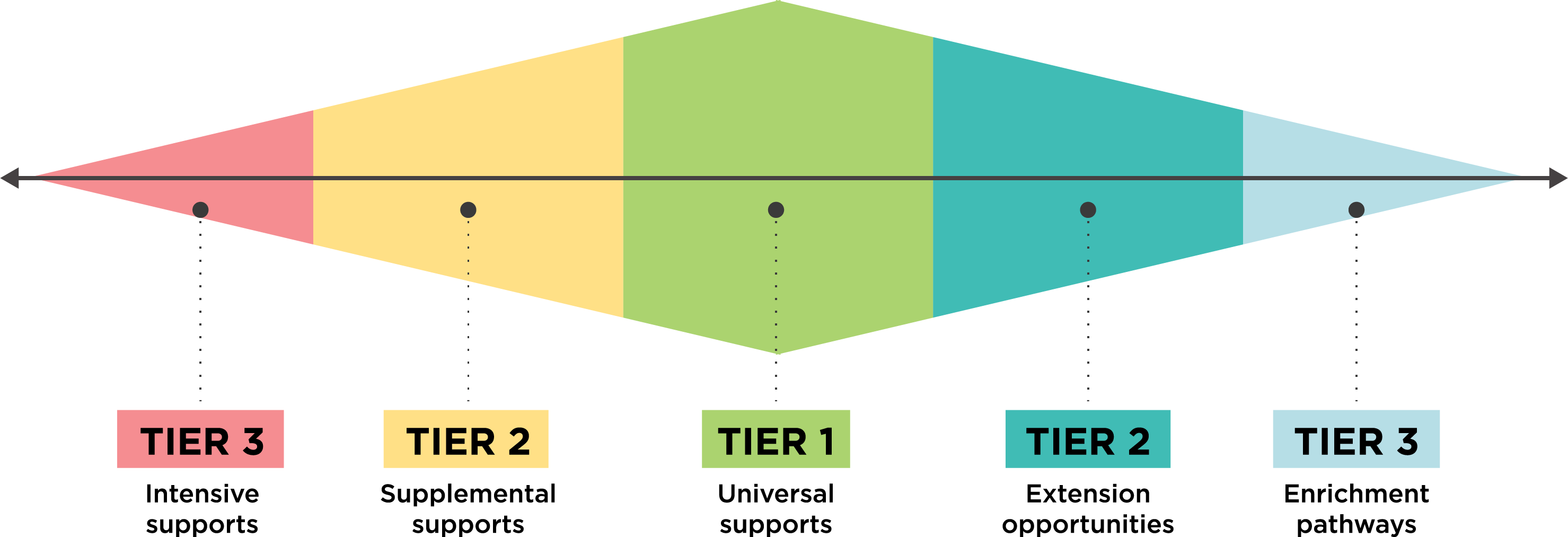 Traditional tiered models have helped schools organize support, but they can also make tiers feel like places students occupy. The diamond gives us a different picture. It shows one coherent system anchored in Tier 1, with pathways extending in multiple directions toward both support and challenge.
On one side of the diamond are supplemental supports and intensive supports that help learners access grade-level learning. On the other side are extension opportunities and enrichment pathways that deepen, expand, and apply learning in meaningful ways. A complete MTSS system designs both sides intentionally. If MTSS is truly for all learners, then challenge cannot be left to chance any more than support can.
A helpful way to think about the diamond is that it makes imbalance easier to see. In many systems, the support side is much more developed than the challenge side. There may be clear routines for identifying students who need intervention, but fewer routines for noticing students who are ready for depth, complexity, transfer, or authentic application. That does not mean educators do not value challenge. It often means the system has not designed challenge with the same clarity it has designed support. A complete MTSS system makes both visible, both intentional, and both connected to Tier 1.
When teams use the diamond well, their conversations begin to change. Instead of asking only who needs intervention, they begin asking what current evidence suggests about access, readiness, support, extension, enrichment, and movement. They look for places where many learners need the same support, which may signal something to strengthen in Tier 1. They also look for places where readiness is emerging but challenge has not yet been designed.
The diamond is not just a visual. It helps teams make more complete decisions without turning pathways into learner identities.
Name the response without naming the learner
This may be one of the most important mindset shifts in the whole conversation: students are not the tiers. They are not Tier 2 students, Tier 3 students, intervention students, advanced students, or enrichment students. They are learners whose strengths, needs, readiness, confidence, language, background knowledge, and engagement shift across contexts, tasks, and time.
This is why learner variability and jagged learner profiles matter. A learner may need support with one concept and enrichment with another. A multilingual learner may need language scaffolds while also demonstrating sophisticated reasoning. A student receiving specialized education services may need individualized support and still deserve access to complex thinking, authentic application, and meaningful challenge. A coherent MTSS system does not ask learners to fit static categories. It asks the system to keep adjusting so learners can access, deepen, and extend meaningful learning.
This matters because language has a way of shaping what students believe about themselves. A student who hears, “You are in intervention,” may hear that as a statement about who they are. A student who hears, “We are giving you another way into this skill right now,” is more likely to understand support as a response to learning. The same is true for challenge. When pathways are described as temporary responses, movement becomes easier for educators to plan and easier for students to understand.
Make movement a natural part of learning
If access is not a place, then movement cannot be something that only happens once in a while. Learners should be able to move into, within, across, and out of support, extension, and enrichment pathways based on what the evidence shows right now. Movement is not a reward. It is not a release. It is not proof that a student has become a different kind of learner. Movement is the system adjusting its response so learning stays reachable, meaningful, and appropriately challenging.
That means every pathway decision needs a review point. Teams need to know when they will come back and ask, Is this response still the right fit? Is it helping? Does it need to continue, shift, fade, intensify, or be paired with challenge? Those questions keep support from becoming a ceiling, enrichment from becoming a fixed privilege, and pathways from becoming placements.
Movement becomes especially important when teams work close to instruction. Annual benchmarks and larger assessments matter, but learners do not wait for the next testing window to change. Readiness can appear during a discussion, confusion can become visible in a piece of student work, and access can shift during a unit. A responsive system needs short-cycle routines that help teams notice those changes while there is still time to act. That may mean adjusting a support group, pairing support with challenge, changing the representation used in Tier 1, or creating an extension opportunity tied to the same learning target.
For students, movement should feel understandable and ordinary. A learner should be able to say, “I am getting more support with this part of the learning right now,” or “I am ready to take this idea deeper,” without feeling that either pathway defines them. That requires adult language, student-facing explanations, and review routines that make movement feel like part of learning rather than a label, reward, or correction.
Use student experience to strengthen the system
A system designed for learners is stronger when it is also designed with them. Student voice, agency, and co-ownership are not just nice engagement strategies. They help the system become more accurate. Educators can see structures, schedules, and outcomes, but students can tell us how those structures actually feel and function from the inside.
Students can tell us whether support feels connected to what they are learning or separate from it. They can tell us whether extension feels like deeper thinking or just more work. They can tell us whether movement feels responsive, confusing, or stigmatizing. When goal setting, reflection, and feedback are treated as real system inputs, MTSS becomes more responsive because it is informed by the people living inside it every day.
Student partnership is also a practical strategy for improving system accuracy. Educators may believe a support block is clear, but students may experience it as disconnected. Educators may design an enrichment task with good intent, but students may experience it as extra work that does not connect to the learning. Educators may create movement routines, but students may not understand why they are moving or when the response will be reviewed. When students are invited to reflect on these experiences, the system gains evidence it cannot get from scores alone, which leads naturally into how teams use evidence more broadly.
Turn evidence into the next learning move
Outcomes matter, but they are not the whole story. They should not be used only as endpoints that confirm performance. Outcomes can also help teams understand how the system is functioning. They can show whether learners are experiencing access, challenge, movement, and belonging in the ways the system intends.
Purposeful evidence use means teams know what each evidence source is for and what decision it should inform. Screeners help identify broad patterns. Diagnostics clarify specific access points or misconceptions. Progress monitoring shows whether a current response is working. Pre-unit pulse checks help teams anticipate support and depth before instruction begins. Daily formative evidence helps teachers and teams adjust while learning is still unfolding. When evidence has a clear purpose, data conversations become less about pressure and more about precision.
The goal is not to collect more data. Most schools already have plenty of it. The goal is to make sure the evidence has somewhere useful to go. A data conversation should not end with a list of students, a color-coded chart, or a general concern. It should end with clarity about what students will experience differently because the team looked closely at the evidence. That might be a change in Tier 1 modeling, a temporary support pathway, an extension task, a feedback conference, or a review point for movement. Evidence becomes powerful when it changes the next learning experience.
A small shift in questions can make a big difference. Instead of stopping at, Who is below benchmark? teams might ask, What does this evidence tell us about access to the current learning? Instead of asking only, Who needs intervention? they might ask, What response would help this learner engage more meaningfully with the next part of the unit? And instead of asking, Did the student meet the cut score? teams might ask, What do we know now that should shape the next learning move? Those questions keep data connected to instruction rather than letting it become a sorting tool.
Protect the time and teaming that make responsiveness possible
MTSS cannot hold on belief alone. It needs time and teaming structures that make the work possible.
Time is infrastructure. Common planning time gives educators a place to interpret evidence and design responses. WIN time, or flexible instructional time, gives learners a place to experience connected support, extension, enrichment, feedback, and movement. Leadership time gives the system a place to step back and ask whether the design is actually holding.
Teams also need distinct roles. MTSS does not live in one committee or one coordinator. It’s a structure everyone owns. District leaders define non-negotiables that protect coherence across schools. Building leaders translate those expectations into schedules and routines. PLCs and content teams make short-cycle instructional decisions close to current learning. Student support teams bring precision when individualized expertise or coordination is needed. When each team knows the decisions it owns and the decisions it informs, evidence can move through the system more reliably.
This is why MTSS is leadership work. Not because leaders make every instructional decision, but because leaders design the conditions that make strong decisions possible. Teachers cannot create system coherence on their own if schedules do not protect planning time, if pathway language is unclear, if evidence arrives too late to shape instruction, or if challenge is left to individual creativity. Leaders protect the architecture by aligning time, roles, evidence routines, and expectations so educators can do responsive work with more consistency and less reinvention.
One practical way to see time and teaming working together is to follow a single evidence cycle. A PLC reviews student work on Tuesday and notices that some learners need a clearer representation, while others are ready for a more complex application. The team uses common planning time to design both responses. Students experience those responses during flexible instructional time later that week. At the next PLC, the team reviews what changed, who moved, and what Tier 1 may need next. That simple rhythm—evidence, planning, response, review—is what turns MTSS from a set of meetings into a working system, and it also creates the conditions for equity to become part of everyday design.
Build equity into Tier 1, pathways, and everyday decisions
Equity cannot be something MTSS addresses only after patterns show up in the data. Equity has to be designed into the system from the start. That means designing Tier 1 so students experience access, rigor, and belonging together. It means studying learner group patterns without reducing students to categories or creating separate silos of support. It means asking who consistently has access to the full promise of MTSS: strong Tier 1 instruction, timely support, meaningful challenge, belonging, voice, and movement.
A proactive equity design asks what the system needs to make possible before inequitable patterns become predictable. It does not wait for students to need additional support before access is strengthened, or for certain students to prove readiness before challenge is offered. It asks whether every learner has a meaningful way into the work, a meaningful reason to stay with the work, and a meaningful opportunity to move forward through the work.
Access, rigor, and belonging have to live together in Tier 1. Access without rigor can unintentionally lower the ceiling. Rigor without access can make learning feel unreachable. Belonging without meaningful intellectual participation can feel warm but thin. When all three are designed together, students are invited into learning that is reachable, challenging, and connected to who they are as contributors. That is the kind of Tier 1 design that makes equity visible before a data report ever names a gap.
Equity also requires leaders to study patterns without flattening learners into categories. It is important to know which learner groups are accessing support, challenge, belonging, voice, and movement, but those patterns should lead the system back to design questions. Are multilingual learners receiving language access without losing challenge? Are students receiving specialized education services participating fully in Tier 1, extension, and enrichment when evidence shows readiness? Are learners with inconsistent attendance given meaningful re-entry points that preserve access to both support and depth? These questions keep responsibility with the system while honoring the complexity of individual learners. They also remind leaders that equity has to be sustained over time, not only named in the moment.
Sustain the core commitments as conditions change
Many MTSS efforts do not fall apart at the beginning. They weaken later, when a leader leaves, funding changes, schedules shift, new priorities compete for attention, or the work depends too much on a few committed people. A durable MTSS system keeps functioning with coherence, access, movement, and equity even as conditions change.
Durability does not mean preserving every structure exactly as it was first designed. It means protecting the core purpose while allowing the system to adapt. Durable MTSS is embedded in improvement planning, coaching, professional learning, teacher leadership, student partnership, budgeting, onboarding, and leadership review. It is not carried by one champion or one initiative. It is carried by shared commitments made real through protected routines.
Durability depends on what gets protected when the work becomes difficult. It is easy to value MTSS when there is a launch plan, a professional learning series, a grant, or a strong leader championing the effort. The real test comes when the calendar fills, staffing shifts, competing initiatives arrive, or familiar habits return. Durable systems have routines that help leaders notice drift early. They revisit non-negotiables, study movement patterns, review access to support and challenge, listen to student experience, protect time, clarify team roles, and align coaching and professional learning to the routines the system needs to sustain.
In practical terms, this means leaders protect more than a schedule or a form. They protect the language that keeps learners separate from labels. They protect the review routines that keep movement alive. They protect student partnership so the system continues to learn from the learner experience. They protect the expectation that support and challenge remain visible together, even when time is tight or another priority feels urgent. Durability is built through the small, repeated leadership choices that keep the core commitments from drifting to the margins.
Keep the learner promise at the center
In the end, MTSS is a promise the system makes to learners. It is the promise that no learner will be reduced to one score, one label, one pathway, or one moment in time. It is the promise that Tier 1 will stay strong enough to anchor the system, that support will not become a ceiling, that challenge will not become a privilege, and that movement will remain possible as learners grow.
For leaders, the most important question may not be, Do we have MTSS? Many schools can point to teams, assessments, interventions, schedules, and data meetings. The better question is, What are learners experiencing because of the way our system is designed? Are they experiencing Tier 1 as meaningful and accessible? Are they receiving support without being separated from the intellectual work of the classroom? Are they accessing challenges when readiness appears? Do they understand why pathways change? Do educators study patterns in movement, access, and experience as evidence of system function? These questions move MTSS from implementation activity to system learning.
When MTSS is designed this way, the work becomes both more disciplined and more human. It is more disciplined because teams use evidence, review points, common language, and protected routines to make decisions. It is more human because those decisions are ultimately about dignity, belonging, opportunity, and the stories learners come to believe about themselves. A pathway can communicate possibility or limitation. A support block can feel like access or separation. An enrichment opportunity can feel like invitation or exclusivity. The difference depends on the design.
The work of MTSS is the work of building a system worthy of the learners inside it: strong enough to hold complexity without losing coherence, responsive enough to adjust without sorting, durable enough to keep improving without losing its purpose, and human enough to remember that every schedule, pathway, meeting, data conversation, and leadership decision ultimately points back to what the system is making possible for students.